Government Help With Energy Bills
Energy bills remain one of the main household costs that can place pressure on people across the UK. For households on low incomes, pensioners, disabled people, carers, families and people facing short-term financial difficulty, the cost of gas and electricity can be difficult to manage.
Government help with energy bills can come in several forms. Some support is applied directly to an electricity bill. Some is paid automatically to eligible households. Other help may come through local councils, energy suppliers, hardship funds, winter payments or home energy-saving schemes.
The type of support available depends on where you live, your income, your benefit status, your age, your household circumstances and the scheme rules in place at the time.
This guide explains the main types of help that households may be able to check, how energy bill support usually works and what to do if you are struggling to keep up with payments.
What Help With Energy Bills Can Include
Help with energy bills does not always mean a direct cash payment. In many cases, support is applied as a discount, credit, voucher, grant or reduction.
For example, the Warm Home Discount is usually applied to an electricity account rather than being paid into a bank account. Local council support may be provided as vouchers, emergency help or direct assistance with essential costs. Supplier hardship schemes may help with arrears, repayment plans or specific energy-related needs.
Some energy support is national. Other help is local or supplier-specific. This means there is no single route that works for everyone.
If you are looking more widely at financial help from the UK government, it can be useful to check energy bill support alongside benefits, council tax help, housing support and local crisis schemes.
Warm Home Discount
The Warm Home Discount is one of the best-known forms of government help with energy bills.
It is a one-off discount on an electricity bill for eligible households. It is not normally paid as cash. Instead, the supplier applies the discount to the account.
Eligibility depends on the rules for the relevant winter and where you live. In England and Wales, households may qualify if they receive the Guarantee Credit element of Pension Credit or are on a low income and meet the scheme criteria. In Scotland, rules can be different for some low-income households, and some people may need to apply through their supplier.
The Warm Home Discount is not available in Northern Ireland, where different support may apply.
A key point is that the scheme is seasonal. If the scheme has closed for one winter, households may need to wait for the next opening period or check whether they missed any required action from a previous letter.
Winter Fuel Payment
Winter Fuel Payment is aimed at older people and is designed to help with heating costs during colder months.
Eligibility is based mainly on age and circumstances during the qualifying period. People who live in Scotland do not receive the standard Winter Fuel Payment, but may be able to access the Pension Age Winter Heating Payment instead.
For some households, Winter Fuel Payment may be paid automatically. Others may need to claim, depending on their circumstances.
It is important to check the current rules before relying on this support. Eligibility, payment amounts and recovery rules can change, and higher-income pensioners may be affected by tax-related recovery arrangements.
Older people on a low income should also check whether they may be entitled to Pension Credit, because Pension Credit can open the door to other forms of help.
Cold Weather Payment
Cold Weather Payments are available in England, Wales and Northern Ireland for some people receiving certain benefits.
They are triggered when the average temperature in a person’s area is recorded or forecast to be zero degrees Celsius or below for seven days in a row during the eligible winter period.
The payment is intended to help with extra heating costs during very cold weather. It is not available all year, and it is not paid simply because someone has a high energy bill. It depends on both eligibility and weather conditions.
People in Scotland do not receive Cold Weather Payments in the same way. Scotland has its own winter heating support arrangements.
Cold Weather Payments are usually automatic for those who qualify, but it is still worth checking official information if you think you should have received one and have not.
Local Council Energy Support
Local councils can be an important source of help for people struggling with energy costs.
Depending on the area, council support may help with energy bills, food, essential items, water bills, emergency costs or wider household pressure. This support is often aimed at people facing hardship or crisis.
The exact help available varies between councils. One council may offer vouchers, another may offer direct help with bills, and another may work with local charities or advice organisations.
Because local schemes differ, households should check their own council’s website rather than relying only on national information.
This type of support can be especially important for people who do not qualify for national energy schemes but are still struggling with essential costs.
Energy Supplier Support
If you are struggling to pay your energy bill, your supplier should usually be one of the first organisations to contact.
Energy suppliers may be able to offer payment plans, review existing direct debits, give more time to pay, discuss debt repayment, offer temporary payment reductions or explain hardship support.
Some suppliers have grant schemes or charitable funds for customers in debt or facing serious difficulty. The rules vary by supplier, and some schemes may be open only to that supplier’s customers.
If you have energy debt, it is usually better to contact the supplier early rather than wait until the situation becomes more difficult.
A supplier may ask for details of income, spending, benefits, household circumstances or vulnerability. This can help them assess what support may be appropriate.
Priority Services Register
The Priority Services Register is not a payment, but it can be useful for people who need extra help from their energy supplier or network operator.
It may be relevant for older people, disabled people, people with long-term health conditions, households with young children, people with communication needs or those who are temporarily vulnerable because of a life event.
Support may include advance notice of planned power cuts, help reading meters, accessible communication, priority support in an emergency or extra consideration if supply is interrupted.
Each supplier has its own Priority Services Register, and households may also need to register with their local network operator.
This support will not reduce a bill by itself, but it can make dealing with energy services easier and safer for people who need additional assistance.
Help If You Use A Prepayment Meter
People using prepayment meters can face particular difficulties if they cannot afford to top up.
If you cannot top up your gas or electricity meter, your supplier may be able to provide temporary credit. This usually has to be repaid, so it should not be treated as free support.
Some people may also be able to access a fuel voucher through a local council, food bank, charity or advice organisation. A fuel voucher is normally a code that can be used to add credit to a gas card or electricity key.
Support for prepayment customers can depend on the supplier, location and circumstances. If you are at risk of being left without heating or power, it is important to contact the supplier and local support organisations as soon as possible.
Energy-Saving Improvement Schemes
Some government support is designed to reduce energy use rather than pay a bill directly.
This can include schemes that help with insulation, heating improvements, energy efficiency upgrades or home changes that make a property cheaper to heat.
Examples may include the Energy Company Obligation, the Great British Insulation Scheme and local home upgrade support. Eligibility can depend on income, benefits, property type, energy performance rating, council tax band or postcode.
These schemes may not solve an immediate bill problem, but they can help some households reduce future energy costs.
Because eligibility rules can be specific, households should check current scheme details before assuming they qualify.
Energy Support And Cost Of Living Payments
Some people searching for energy bill help may also search for cost of living payments.
It is important to separate older cost of living payments from current energy support. Previous cost of living payments were linked to specific qualifying dates and payment periods. They were not a permanent energy bill scheme.
If you are trying to understand what happened with previous payments, our guide to UK cost of living payments explained sets out how those payments worked and why older information can be misleading.
For current help, it is usually better to check active support routes such as the Warm Home Discount, winter payments, local council help, benefits, supplier hardship funds and energy-saving schemes.
One-Off Help With Energy Costs
Some households may need one-off help because of an unexpected bill, debt problem, broken heating system, emergency top-up need or sudden change in income.
One-off energy help may come through a local council, supplier hardship fund, charity, welfare scheme or crisis support route.
This type of help is not always guaranteed. It may depend on local funding, evidence of hardship, household vulnerability or whether the applicant has already received support.
If you are looking for emergency support, our article on sourcing one-off payments from the UK government explains how to approach short-term help and where to check first.
How To Check What You Might Be Entitled To
A practical way to search for energy bill help is to work through the main routes one at a time.
Start by checking whether you qualify for national schemes such as the Warm Home Discount, Winter Fuel Payment or Cold Weather Payment.
Next, check your local council website for crisis support, local welfare help or energy-related assistance.
Then contact your energy supplier if you are behind on payments, struggling with direct debits, unable to top up or worried about debt.
It may also be worth using a benefits calculator, especially if your income has changed. Some energy support depends on benefits, and claiming the right benefit can make a difference to wider eligibility.
For a broader overview of the different types of support available, see our guide to government financial support programmes in 2026.
Avoiding Energy Support Scams
Energy bill support can attract scams, especially when people are worried about money.
Be careful with texts, emails or social media messages claiming that you must apply immediately for an energy payment. Scam messages may ask for bank details, passwords, card information or a fee.
Official support schemes normally use recognised government, council or supplier channels. If a message includes a suspicious link or creates pressure to act quickly, do not enter personal information.
It is safer to go directly to GOV.UK, your council website or your supplier’s official website.
Clear Information About Household Finance
Energy support can be difficult to understand because it involves government schemes, suppliers, councils, seasonal payments and local rules.
Commerce Grants publishes clear guides on household finance, grants, government support and cost-of-living topics. Writers who want to contribute a finance article or explain practical money issues for readers can review our Write For Us Finance page.
Good financial guidance should be careful, current and easy to understand. This is especially important when people are searching for help with essential costs.
Conclusion
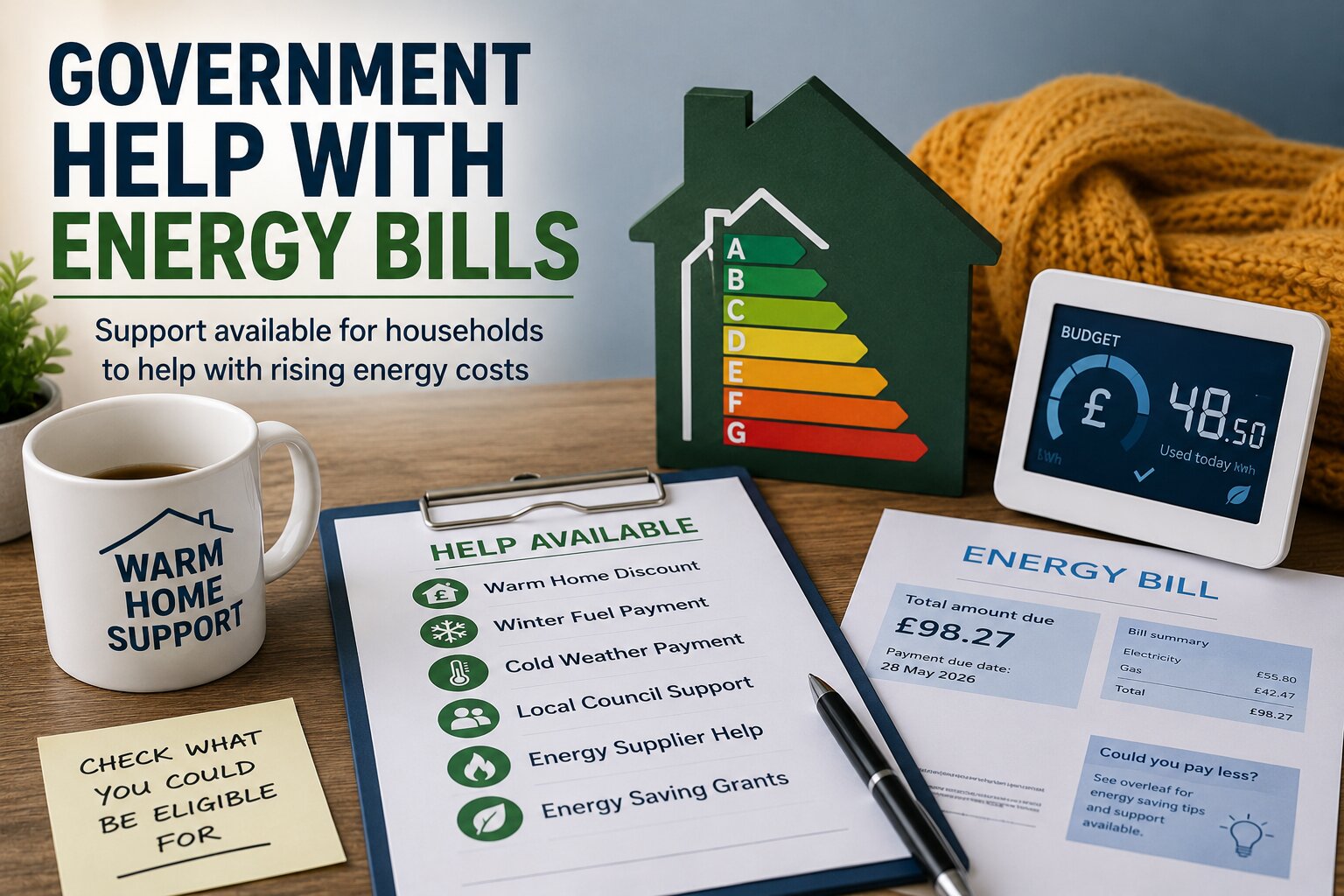
Government help with energy bills can include the Warm Home Discount, Winter Fuel Payment, Cold Weather Payment, local council support, supplier hardship schemes, fuel vouchers, prepayment meter support and energy-saving improvement schemes.
The right route depends on your circumstances, where you live and the rules of each scheme. Some support is automatic, some requires an application, and some depends on local funding or supplier criteria.
If energy bills are becoming difficult to manage, check national schemes, contact your supplier, look at local council support and review whether you may qualify for wider government help.
Energy support can change over time, so always check current information before assuming that a scheme is open or that eligibility rules are the same as in previous years.