Getting Financial Assistance For Older Adults
Getting financial assistance for older adults in the UK often means navigating several different support systems rather than applying for one single payment. Help may be available through pension-age income support, disability-related benefits, heating assistance, council-based hardship schemes and other cost-of-living measures, but the exact mix depends on age, income, health needs, living arrangements and where in the UK the person lives. GOV.UK’s official guidance reflects this structure by separating support into distinct routes such as Pension Credit, Attendance Allowance, Winter Fuel Payment and wider cost-of-living help.
One of the most important starting points for many older adults is Pension Credit. GOV.UK describes Pension Credit as a tax-free income-related benefit for people who have reached the qualifying age and live in Great Britain, and says it is intended to top up income for those on a low income. GOV.UK’s Pension Credit guidance also explains that there are two parts to the benefit: Guarantee Credit, which tops up weekly income to a minimum level, and Savings Credit, which is only available to people who reached State Pension age before 6 April 2016. That matters because “older adult support” is often discussed in broad terms, while in practice much of the low-income help for pension-age households is channelled through this specific benefit.
Pension Credit is often described as especially important because it can do more than increase weekly income on its own. GOV.UK’s technical and payment guidance shows that extra amounts can apply in some situations, including where someone is a carer, severely disabled, or responsible for a child or young person. GOV.UK’s 2026 government update on pensioner support also says Pension Credit will rise by 4.8% and be worth an average of £4,300 a year, while unlocking wider help with housing costs, council tax and free TV licences. In other words, for some older adults, Pension Credit is not just one benefit among many; it can be the gateway that makes other assistance available or easier to access.
Another major route is Attendance Allowance, which is relevant for older adults with care or supervision needs. GOV.UK says Attendance Allowance helps with extra costs if a person has a disability or health condition severe enough that they need help looking after themselves, and that it applies to people who are State Pension age. GOV.UK’s eligibility page also notes an important geographical distinction: in Scotland, people need to apply for Pension Age Disability Payment instead of Attendance Allowance. That is a useful example of how “UK support” can differ by nation, even where the underlying purpose of the payment is similar.
Attendance Allowance can also be more valuable than it first appears because of its connection to other entitlements. GOV.UK says the lower rate is £76.70 a week and the higher rate is £114.60 a week, depending on the level of help or supervision needed. GOV.UK also says that if someone gets Attendance Allowance, they may qualify for extra Pension Credit, Housing Benefit or Council Tax Reduction. This matters because older adults with health needs may sometimes focus only on the immediate weekly payment, when the bigger financial effect may come from the way that award changes their overall support picture.
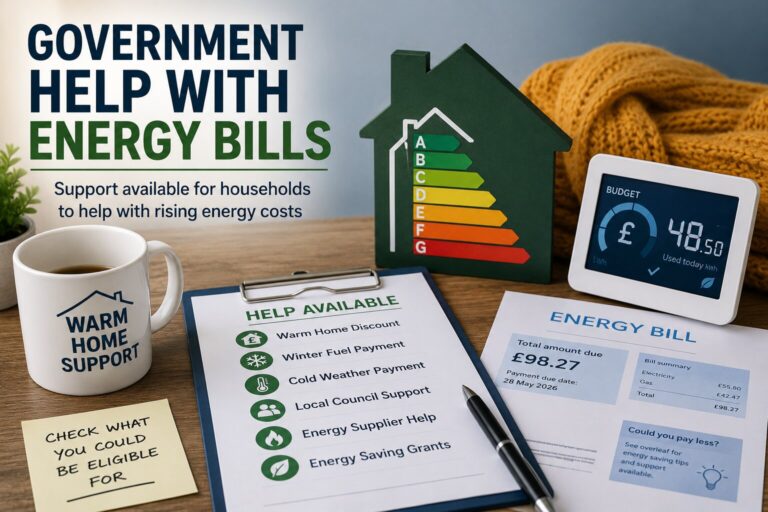
Heating support is another important theme for older adults, especially given the role energy costs can play in household hardship. GOV.UK says that if a person was born before 28 June 1960, they could get between £100 and £300 to help with heating bills for winter 2026 to 2027 through the Winter Fuel Payment. GOV.UK’s Winter Fuel overview presents this as support for older people with heating costs, but it also makes clear that eligibility is not simply about age in the broadest sense. The amount and entitlement depend on date of birth and other circumstances, and some situations require a claim rather than an automatic payment.
There are also important limits and qualifications within Winter Fuel support. GOV.UK states that if a person’s total income is over £35,000, HMRC will take the Winter Fuel Payment back. GOV.UK’s eligibility guidance also explains that people can still get Winter Fuel Payment in some care-home situations, but there are exclusions for some residents who have lived in a care home for the whole relevant period while receiving certain income-related benefits. These details matter because older online summaries often present Winter Fuel support as a universal pension-age payment, whereas current official guidance shows a more conditional picture.
The broader 2026 cost-of-living context is also worth understanding. GOV.UK’s cost-of-living overview says there will be no Cost of Living Payment for 2026, and the older Cost of Living Payments guidance now clearly describes those payments as covering the period from 2022 to 2024. This is highly relevant for older adults and their families because search results and informal articles may still focus on those earlier lump-sum payments, even though the current support landscape has shifted back toward ongoing benefits, bill support and local schemes.
That broader landscape includes current household support measures as well as benefit payments. GOV.UK’s 2026 cost-of-living announcement says the full New State Pension will rise by 4.8% to £241.30 a week, and that from April 2026 the government is removing an average of £150 of costs from household energy bills automatically. Although those measures are not usually described as “financial assistance” in the same way as Pension Credit or Attendance Allowance, they still form part of the real financial picture for older households and affect how pressure on living costs is discussed in official policy updates.
Local councils can be another important source of help, especially where an older adult is facing a short-term problem or an essential-cost crisis. GOV.UK’s cost-of-living pages say support may be available from local councils with utility bills, food, essential items and housing costs, and this sits alongside Council Tax Reduction and other local forms of assistance. In England, GOV.UK has also moved from the earlier Household Support Fund framework toward a Crisis and Resilience Fund approach, which is designed to help low-income households experiencing financial shocks and essential-cost pressures. That means the route into help may sometimes be local rather than national, particularly where the issue is urgent or practical rather than long term.
This local element matters because not every older adult’s difficulty fits neatly into a national benefits category. Someone may have a pension that is too high for one means-tested route but still struggle with a sudden burst of costs tied to heating, food, household repairs or an interrupted income pattern. Council support and local hardship schemes can sometimes address that kind of gap. GOV.UK’s local-support structure suggests that financial assistance for older adults is not only about whether someone receives one major pension-age benefit, but also about whether they can access practical local help during periods of strain.
Some of the processes involved can be somewhat complicated, especially for older people who may be dealing with other challenges. That’s why some people recommend sorting out Power of Attorney, in order to ensure that a trusted individual can handle many elements on behalf of an elderly friend or relative.
The term “older adults” also covers a wider range of situations than terms like “pensioners” or “elderly” sometimes imply. One person may be newly over State Pension age and mainly concerned with income top-up and heating costs. Another may be coping with disability-related needs and looking at Attendance Allowance or its Scottish equivalent. Another may be in later old age with supported-living or care-home questions that affect how different benefits apply. In that sense, financial assistance for older adults is best understood as a layered framework built around age, income, disability, heating costs and local hardship rather than a single headline entitlement.
It is also worth noting that official and local messaging in 2026 continues to encourage older residents to review whether they might qualify for support they are not currently claiming. Local council communications around Pension Credit and Attendance Allowance have emphasised that some older adults may be missing out simply because they do not realise which benefits interact or how one successful claim may strengthen entitlement elsewhere. That suggests that one of the biggest barriers is not always the absence of support itself, but the complexity of identifying the right route.
For families, carers or advisers helping an older adult, the practical lesson is that support should usually be looked at as a combination. Pension Credit may help with low income. Attendance Allowance may help with extra costs linked to disability or health conditions. Winter Fuel support may help with heating. Local-council and cost-of-living schemes may help with essentials or short-term pressure. The official 2026 position strongly supports that way of understanding the system: not as one “older adult fund,” but as several overlapping types of help with different purposes.
A sensible starting point is usually the official GOV.UK pages for Pension Credit, Attendance Allowance and Winter Fuel Payment, followed by the relevant local council’s support pages for essential-cost or crisis help. Those routes are the most likely to reflect current rules, especially where older temporary schemes have ended and newer local frameworks are being introduced.
This article is for general information only and does not constitute financial or professional advice. Readers should check GOV.UK and their local council for current eligibility rules, payment details and application routes.