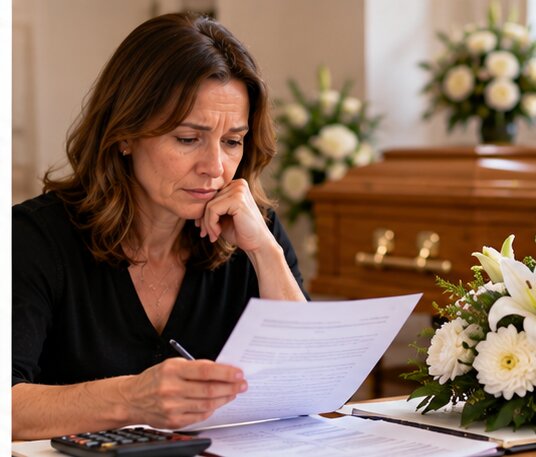
Are There Grants To Help With Funeral Costs?
Arranging a funeral can create a substantial financial burden at an already difficult time.
If I have little money available, there is government help with funeral costs in certain circumstances. Charitable support may also be available.
However, the main government payment does not necessarily cover the entire funeral bill, and eligibility rules apply.
I would investigate help as early as possible rather than committing to a funeral package on the assumption that the government will reimburse everything.
What Is Funeral Expenses Payment?
If I live in England or Wales and receive certain qualifying benefits, I may be able to claim Funeral Expenses Payment.
Northern Ireland has its own application arrangements.
Scotland uses a different benefit called Funeral Support Payment.
Funeral Expenses Payment can contribute towards particular necessary funeral costs where I meet both the benefit and relationship rules.
Which Benefits Can Qualify Me?
Qualifying benefits include Universal Credit, Pension Credit, Housing Benefit and certain income-related benefits.
There are additional qualifying circumstances.
I or my partner normally need to receive one of the specified benefits.
If I have applied for a qualifying benefit but am still waiting for a decision, I may still be able to make a Funeral Expenses Payment claim.
I would check the complete current list rather than assuming that any benefit automatically qualifies.
Does My Relationship To The Person Matter?
Yes.
The rules consider my relationship to the person who died.
For example, a partner of the deceased can potentially qualify.
There are also provisions relating to parents responsible for a child and, in certain circumstances, close relatives or friends.
Eligibility can become more complicated if another close relative could reasonably be expected to pay for the funeral.
I would therefore check the relationship rules before assuming I qualify simply because I am arranging the funeral.
What Can Funeral Expenses Payment Cover?
It can help with particular burial or cremation costs.
It can also cover certain necessary travel, documents and transportation of the body in qualifying circumstances.
In addition, the payment can currently provide up to £1,000 towards other funeral expenses such as the coffin, flowers or funeral director’s fees.
That does not mean I will receive £1,000 plus every penny of the remaining funeral bill.
The final amount depends on the circumstances.
Will It Pay For The Whole Funeral?
Usually not.
Government guidance specifically warns that Funeral Expenses Payment will not normally cover all funeral costs.
This is important when choosing arrangements.
I would ask the funeral director for clear prices and explain that I may be relying on government support.
I would avoid agreeing to expensive optional additions before understanding how much money I have available.
Does The Deceased Person’s Estate Matter?
Yes.
Money available from the deceased person’s estate can affect the position.
Funeral Expenses Payment can be recovered from money I receive from the estate under the applicable rules.
Other available money, such as certain insurance arrangements, can also affect how much support is paid.
I would disclose the circumstances accurately when applying.
What If There Was A Prepaid Funeral Plan?
A prepaid funeral plan can substantially change what remains to be paid.
Current Funeral Expenses Payment rules limit the additional payment available for items not covered by a prepaid plan.
I would establish exactly what the plan includes before ordering additional services.
The funeral director or plan provider should be able to explain what has already been purchased.
When Do I Need To Apply?
For Funeral Expenses Payment, I must normally apply within six months of the funeral.
I do not necessarily have to wait until after the funeral.
If I have an invoice or signed funeral-director contract rather than merely an estimate, I may be able to apply beforehand.
I would not unnecessarily delay the application, particularly if I am relying on the payment to meet the bill.
What Happens In Scotland?
Scotland has Funeral Support Payment rather than Funeral Expenses Payment.
The eligibility and application process therefore differ.
I would use current Social Security Scotland guidance if I live in Scotland rather than relying on information written for England and Wales.
This is another area where articles referring generally to a “UK funeral grant” can be misleading.
What If I’m Not Eligible?
I would not assume there is no help.
I would first check whether the deceased had savings, insurance, a funeral plan or membership of an organisation that provides assistance.
I could also investigate charitable grants.
Some benevolent funds support people connected with particular occupations, industries, professions or communities.
A grant search can identify possibilities that would not be obvious from the person’s current circumstances.
Can The Council Pay For A Funeral?
Local authorities have responsibilities for arranging certain funerals where nobody else is making suitable arrangements.
This is sometimes called a public health funeral.
It is not simply a grant that I can choose instead of paying for a family funeral.
The circumstances and procedures are different.
If somebody has died without relatives or anybody able to make arrangements, I would contact the relevant council rather than assuming I should personally take responsibility for the costs.
Could Universal Credit Provide Other Help?
A Universal Credit Budgeting Advance can be used for certain one-off costs, including funeral expenses.
This is different from Funeral Expenses Payment.
A Budgeting Advance has to be repaid through future Universal Credit payments.
I would therefore treat it as borrowing rather than a grant.
If I qualify for Funeral Expenses Payment, I would investigate that first.
What If The Funeral Director Wants Payment Quickly?
I would explain the financial position before signing the contract.
Some funeral directors are familiar with Funeral Expenses Payment and may be prepared to discuss payment arrangements.
I would make sure I understand exactly what I am committing to personally.
The existence of a pending government claim does not automatically remove my responsibility for a bill I have agreed to pay.
Keep The Funeral Affordable
This can be emotionally difficult.
There can be pressure to believe that spending more demonstrates how much somebody meant to me.
I would remember that a respectful funeral does not have to be elaborate.
If money is limited, I would ask for a clear breakdown of essential and optional costs.
That allows me to make informed decisions rather than discovering afterwards that the government payment covers much less than expected.
There is genuine help with funeral costs for some low-income households, but I would not describe it as a universal funeral grant. Eligibility, the deceased person’s circumstances and the arrangements I choose all affect how much assistance is available.