Macroeconomic Terms Defined
Macroeconomic terms appear regularly in financial news, government announcements and everyday discussions about the economy. Words such as GDP, inflation, recession, productivity and interest rates can sound technical, but they describe issues that affect households, businesses and public finances.
Macroeconomics looks at the economy as a whole. It studies broad measures such as national output, prices, employment, borrowing, government spending, trade and growth. These ideas can seem abstract, but they help explain why bills rise, why mortgage costs change, why jobs may become harder to find and why governments make difficult tax and spending decisions.
This guide defines common macroeconomic terms in plain English and explains why they matter.
Gross Domestic Product
Gross domestic product, usually shortened to GDP, measures the value of goods and services produced in an economy over a period of time.
In the UK, GDP is one of the main measures used to judge whether the economy is growing or shrinking. If GDP rises, the economy is producing more than before. If GDP falls, the economy is producing less.
GDP can be measured monthly, quarterly or annually. It is often reported as a percentage change, such as 0.3% growth over a quarter.
GDP matters because it can affect jobs, wages, tax receipts, business confidence and public spending. However, it does not show everything about living standards. A country can have rising GDP while some households still struggle with costs.
For a fuller explanation, see our guide to UK GDP explained and how it relates to everyday finances.
Real GDP
Real GDP is GDP adjusted for inflation.
This matters because prices change over time. If the value of goods and services rises only because prices are higher, that does not necessarily mean the economy is producing more.
Real GDP tries to remove the effect of price changes so economists can compare economic output more accurately.
When people talk about economic growth, they are usually referring to real GDP growth rather than nominal GDP growth.
Nominal GDP
Nominal GDP measures the value of goods and services using current prices.
Unlike real GDP, it does not adjust for inflation. This means nominal GDP can rise because prices have gone up, even if the economy is not producing much more.
Nominal GDP can still be useful, especially when looking at tax receipts, public debt or the cash size of the economy. However, real GDP is usually better for understanding whether economic output is genuinely increasing.
GDP Per Capita
GDP per capita means GDP per person.
It is calculated by dividing the size of the economy by the population. This can help give a clearer picture of average economic output for each person.
Headline GDP may rise because the population is growing. But if GDP per capita is flat or falling, people may not feel better off.
GDP per capita is not the same as household income, but it can be useful when thinking about living standards.
Economic Growth
Economic growth means an increase in the value of goods and services produced by the economy.
Growth is usually measured by the change in real GDP. A growing economy can support job creation, higher wages, stronger tax receipts and business investment.
However, growth is not always evenly shared. Some regions, industries or households may benefit more than others.
Long-term economic growth depends on factors such as productivity, skills, investment, technology, infrastructure, trade and stable institutions.
Readers interested in the longer picture can explore the UK economic growth rate through history to see how growth has changed across different periods.
Recession
A recession is commonly described as two consecutive quarters of falling GDP.
A quarter is a three-month period. If GDP falls for two quarters in a row, the economy is usually said to be in recession.
Recessions can lead to lower business confidence, reduced investment, job losses and pressure on public finances. Some recessions are short and mild. Others are deeper and more damaging.
A recession does not mean every business or household is affected in the same way. Some sectors may continue to grow while others struggle.
Inflation
Inflation means prices are rising across the economy.
If inflation is 4%, it means prices are, on average, 4% higher than they were a year earlier. Inflation reduces purchasing power because the same amount of money buys less.
Inflation can affect food, energy, rent, transport, insurance, services and business costs.
A low and stable rate of inflation is often considered normal. High inflation can be difficult because wages, benefits and savings may not keep up with rising prices.
Deflation
Deflation means prices are falling across the economy.
At first, falling prices may sound positive for households. However, widespread deflation can be a sign of weak demand.
If people expect prices to fall further, they may delay spending. Businesses may then reduce production, investment or hiring. This can weaken the economy further.
Deflation is different from lower inflation. Lower inflation means prices are still rising, but more slowly. Deflation means prices are falling.
Interest Rates
Interest rates are the cost of borrowing money or the reward for saving money.
When interest rates rise, loans, mortgages and credit may become more expensive. Savings may earn more interest, but borrowers may face higher repayments.
When interest rates fall, borrowing may become cheaper, but savings returns may be lower.
In the UK, the Bank of England sets Bank Rate, which influences many other interest rates in the economy. Interest rates are often changed to help control inflation or support economic stability.
Monetary Policy
Monetary policy refers to actions taken by a central bank to influence inflation, borrowing, spending and economic activity.
In the UK, monetary policy is mainly handled by the Bank of England. Its best-known tool is Bank Rate.
If inflation is too high, the Bank may raise interest rates to reduce spending pressure. If the economy is weak and inflation is low, it may lower rates to support borrowing and demand.
Monetary policy can affect mortgages, business loans, savings, exchange rates and consumer spending.
Fiscal Policy
Fiscal policy refers to government decisions on taxation, public spending and borrowing.
A government may use fiscal policy to support public services, invest in infrastructure, provide benefits, reduce taxes or manage borrowing.
If a government increases spending or cuts taxes, it may support demand in the economy. If it cuts spending or raises taxes, it may reduce borrowing but can also slow activity.
Fiscal policy affects households and businesses through tax bills, public services, welfare support, grants, investment and government programmes.
Public Debt
Public debt is the total amount the government owes.
It builds up over time when the government borrows money to cover the gap between spending and revenue.
Public debt is often discussed as a percentage of GDP. This shows the debt compared with the size of the economy.
Debt can be used to fund important spending, especially during crises. However, high debt can create pressure because interest payments may take up a larger share of government revenue.
Budget Deficit
A budget deficit occurs when the government spends more than it receives in tax and other income over a particular period.
The deficit is not the same as debt. The deficit is the annual or monthly gap. Debt is the accumulated total owed.
If the government runs deficits year after year, public debt usually rises.
Deficits may increase during recessions because tax receipts fall and spending on support may rise.
Budget Surplus
A budget surplus occurs when the government receives more money than it spends.
Surpluses can be used to reduce debt or build financial capacity for future spending. However, running a surplus may also involve higher taxes or lower spending, depending on the wider economic context.
Budget surpluses are less common than deficits in many modern economies.
Productivity
Productivity measures how much output is produced for each worker or each hour worked.
It is one of the most important long-term drivers of rising living standards. If workers and businesses can produce more value in the same time, wages and profits may be able to rise more sustainably.
Productivity can improve through better technology, skills, infrastructure, management, equipment and investment.
Weak productivity growth can make it harder for wages and living standards to improve.
Unemployment
Unemployment measures people who are not working but are actively looking for work.
A rising unemployment rate can indicate that businesses are reducing hiring or that demand in the economy is weakening.
Low unemployment can be positive, but it does not tell the whole story. Some people may be in insecure work, low-paid work or working fewer hours than they would like.
Economists often look at unemployment alongside wages, vacancies, inactivity and job quality.
Labour Market
The labour market refers to the supply of workers and the demand for jobs.
A strong labour market usually means more people are in work, vacancies are available and wages may rise. A weak labour market may mean fewer vacancies, higher unemployment and lower confidence among workers.
The labour market matters because wages are a major source of household income and employment affects tax receipts, public spending and consumer demand.
Wage Growth
Wage growth measures how pay changes over time.
If wages rise faster than inflation, workers may feel better off in real terms. If wages rise more slowly than inflation, people may feel worse off even if their pay has increased in cash terms.
This is why economists often distinguish between nominal wage growth and real wage growth.
Real Wages
Real wages are wages adjusted for inflation.
If someone receives a 4% pay rise but inflation is 6%, their real wage has fallen because their pay buys less than before.
Real wages are important for understanding living standards. A growing economy may not feel strong to households if real wages are stagnant or falling.
Exchange Rate
The exchange rate is the value of one currency compared with another.
For example, it can show how many euros or dollars one pound can buy.
Exchange rates affect imports, exports, travel, overseas earnings and business costs. A weaker pound can make imports more expensive but may make exports more competitive. A stronger pound can make imports cheaper but may make exports less competitive.
Balance Of Trade
The balance of trade compares the value of a country’s exports with its imports.
If exports are higher than imports, there is a trade surplus. If imports are higher than exports, there is a trade deficit.
The UK has often run a trade deficit in goods, while services such as finance, education, legal services and professional services have played an important role in exports.
Trade figures can affect currency movements, business confidence and economic forecasts.
Current Account
The current account is a broader measure of a country’s transactions with the rest of the world.
It includes trade in goods and services, income from investments and transfers between countries.
A current account deficit means the country is spending or paying more overseas than it receives. A surplus means it receives more than it sends out.
This term appears often in discussions about international economic balance.
Aggregate Demand
Aggregate demand means total demand in the economy.
It includes household spending, business investment, government spending and net exports.
If aggregate demand is strong, businesses may sell more, hire more and invest more. If demand is weak, growth may slow and unemployment may rise.
Policymakers often think about how fiscal and monetary policy affect aggregate demand.
Supply Shock
A supply shock is an unexpected event that affects the supply of goods or services.
Examples include oil price spikes, supply chain disruption, crop failures, pandemics or major geopolitical events.
Supply shocks can reduce output and raise prices at the same time. This can create difficult conditions because the economy may face both weak growth and high inflation.
Stagflation
Stagflation means weak economic growth combined with high inflation.
It is difficult for policymakers because measures to reduce inflation can slow the economy further, while measures to support growth can add to inflation pressure.
The UK and other economies experienced stagflationary pressures during the 1970s, partly linked to oil shocks and inflation.
Business Cycle
The business cycle describes the natural ups and downs of economic activity.
Economies often move through periods of expansion, slowdown, recession and recovery.
The business cycle does not follow a fixed timetable. It can be affected by policy decisions, financial conditions, global events, technology, consumer confidence and business investment.
Understanding the business cycle helps explain why growth rates change over time.
Clear Economic Explanations
Macroeconomic language can make important topics feel more distant than they are. In reality, these terms help explain everyday issues such as prices, wages, jobs, borrowing, public services and government support.
Commerce Grants publishes clear guides on economic topics, finance, grants and public support. Writers who want to contribute a finance article or explain money topics in plain English can review our Write For Us Finance page.
Good economic writing should make complex ideas easier to understand without losing accuracy.
Conclusion
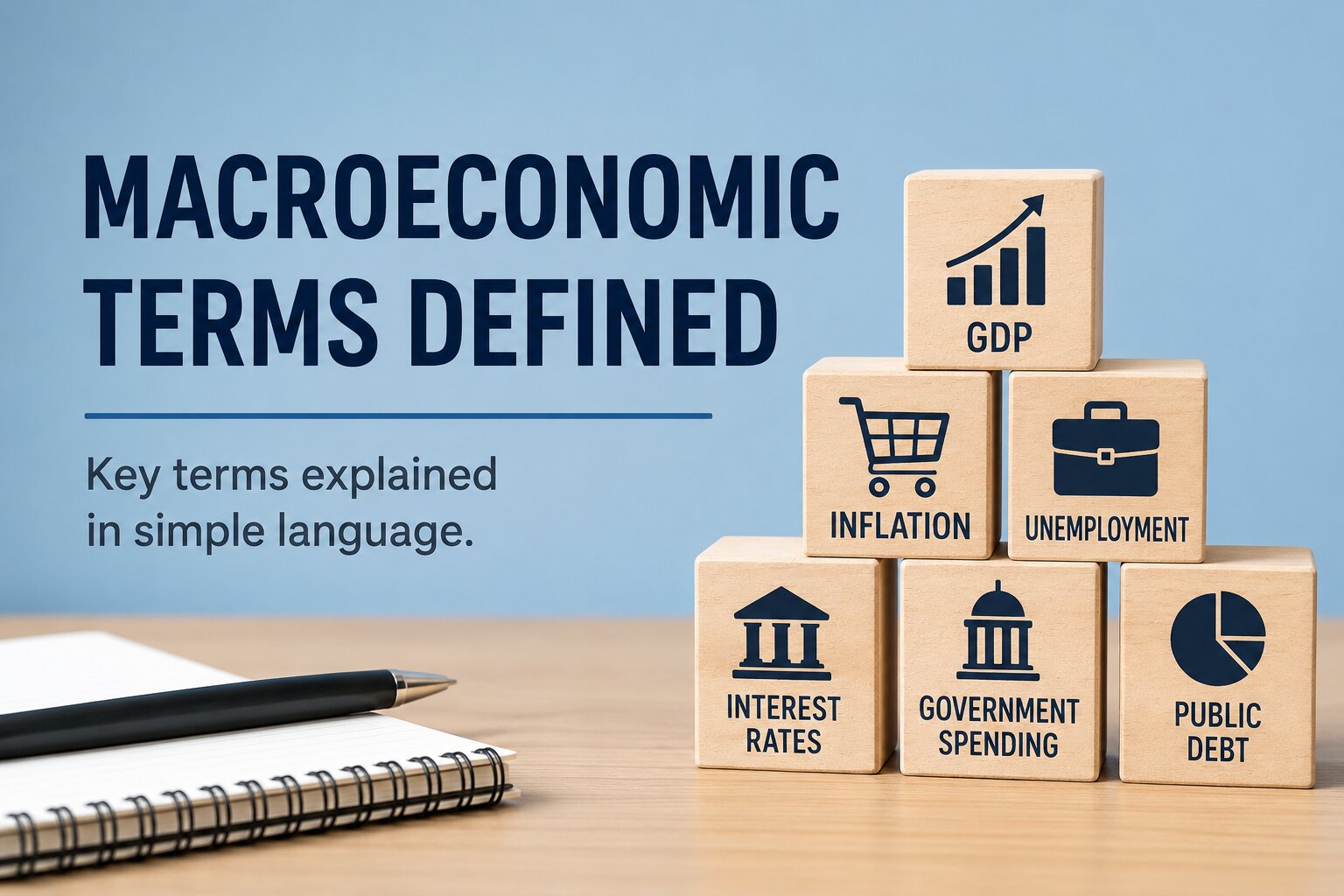
Macroeconomic terms describe the big forces that shape the economy. GDP, inflation, unemployment, productivity, interest rates, public debt and fiscal policy all help explain how the wider economy is performing.
These terms matter because they affect households, businesses and government decisions. They influence wages, jobs, prices, borrowing costs, taxes, public services and financial support.
Understanding the language of macroeconomics makes it easier to follow economic news and judge what official figures may mean in practice.
The terms can seem technical at first, but many of them describe familiar pressures: rising bills, changing mortgage costs, job security, government spending and the overall health of the economy.