UK GDP Explained: What Does It Mean For You?
GDP is one of the most common terms used in economic news, government announcements and financial forecasts. When people talk about whether the UK economy is growing or shrinking, they are usually talking about gross domestic product, or GDP.
At its simplest, GDP measures the value of goods and services produced in a country over a period of time. In the UK, GDP is used to estimate the size of the economy and whether economic activity is increasing, slowing or falling.
That might sound distant from everyday life, but GDP can affect jobs, wages, business confidence, public spending, tax decisions, interest rates and household finances. It does not tell you everything about how people are living, but it is one of the main ways economists and policymakers judge the overall direction of the economy.
Understanding GDP can make economic news easier to follow and help explain why growth figures receive so much attention.
What Does GDP Mean?
GDP stands for gross domestic product.
“Gross” means the total before certain deductions. “Domestic” refers to activity within the country. “Product” refers to the value of goods and services produced.
In plain English, GDP is an estimate of the total economic activity taking place in the UK. It includes goods such as cars, food, machinery and clothing, as well as services such as healthcare, banking, education, construction, retail, hospitality and transport.
When GDP rises, the economy is usually producing more than before. When GDP falls, the economy is producing less.
A growing economy is often linked with higher business activity, stronger employment, increased tax receipts and greater consumer spending. A shrinking economy may suggest weaker demand, lower confidence, falling output or pressure on households and firms.
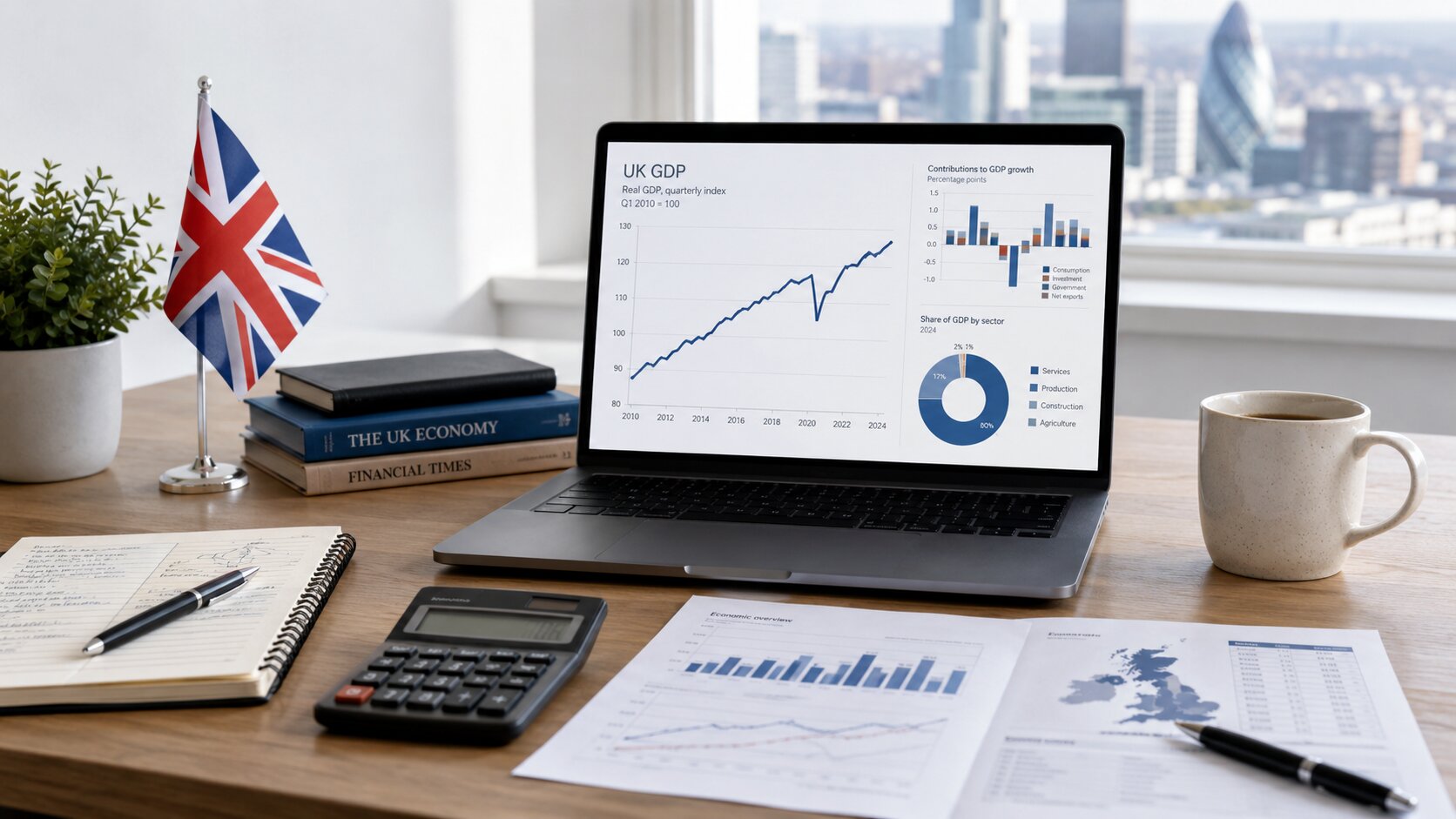
GDP is usually reported as a percentage change. For example, if GDP rises by 0.5% over a quarter, that means the economy is estimated to have grown by 0.5% compared with the previous quarter.
How Is UK GDP Measured?
GDP can be measured in three main ways.
The first is the output approach, which looks at the value of goods and services produced by different sectors of the economy. This includes industries such as services, production, construction and agriculture.
The second is the expenditure approach, which looks at spending. This includes household spending, business investment, government spending and net trade.
The third is the income approach, which looks at income generated in the economy. This includes wages, company profits and taxes less subsidies.
In theory, all three approaches are measuring the same economy from different angles. In practice, they can produce slightly different estimates because no economic dataset is perfect. The figures are then balanced and revised as more information becomes available.
This is why GDP numbers can change after they are first published. An early estimate may be updated when more complete data is collected.
Real GDP And Nominal GDP
When reading about GDP, it helps to understand the difference between real GDP and nominal GDP.
Nominal GDP measures the value of output using current prices. If prices rise because of inflation, nominal GDP can rise even if the country is not producing much more.
Real GDP adjusts for inflation. This makes it more useful when trying to understand whether the economy is actually producing more goods and services rather than simply recording higher prices.
For example, if prices rise sharply and spending increases only because things cost more, nominal GDP may look stronger than the real economy feels. Real GDP helps strip out the effect of price changes.
When news reports talk about economic growth, they usually mean real GDP growth.
GDP Per Person
Headline GDP looks at the whole economy. GDP per person, sometimes called GDP per capita, divides the size of the economy by the population.
This matters because an economy can grow overall while average output per person grows more slowly or even falls.
For example, if UK GDP rises by 1% but the population rises by more than 1%, GDP per person may decline. That could help explain why people do not feel better off even when the economy is technically growing.
GDP per person is not the same as household income, but it can give a better sense of living standards than headline GDP alone.
Why GDP Matters To Households
GDP can affect households in several indirect ways.
When the economy is growing, businesses may be more likely to hire staff, raise wages, invest in new projects or expand operations. This can support employment and income growth.
When the economy is weak, businesses may become more cautious. They may delay recruitment, reduce investment, cut costs or limit pay increases. In a downturn, unemployment can rise and household finances may come under pressure.
GDP can also influence government decisions. Stronger growth can increase tax receipts, giving the government more room to fund services or support schemes. Weaker growth can create pressure on public finances, making spending decisions more difficult.
For households, this can affect public services, benefits, tax policy and government support programmes.
GDP does not show whether every household is doing well, but it helps explain the background conditions that shape household finances.
Why GDP Matters To Businesses
For businesses, GDP is a useful signal of the wider trading environment.
When GDP is growing, demand may be stronger. Customers may be spending more, firms may be investing and lenders may be more confident. This can support business planning and expansion.
When GDP slows, businesses may face weaker sales, higher caution among customers and greater uncertainty. Some firms may delay hiring, reduce stock, pause investment or focus more heavily on cash flow.
Small businesses can be especially sensitive to changes in economic conditions. Even a modest slowdown can affect customer spending, late payments, borrowing confidence or access to funding.
This is why business owners often pay attention to economic growth figures, even if GDP does not describe their individual situation perfectly.
Readers interested in the wider history of growth may also find it useful to look at the UK economic growth rate through history, because today’s figures often make more sense when compared with earlier periods.
GDP And Interest Rates
GDP is one of the indicators considered when central banks and policymakers assess the economy.
If the economy is growing strongly and inflation is high, policymakers may worry that demand is too strong. If the economy is weak, they may worry about unemployment, low confidence and reduced spending.
The Bank of England does not set interest rates based only on GDP. It also looks at inflation, wages, employment, financial markets, global conditions and other data.
However, GDP still matters because it helps show whether the economy is expanding or struggling. Changes in interest rates can then affect mortgages, savings, loans, credit cards and business borrowing.
This is one reason GDP can matter even to people who do not follow economic news closely.
GDP And Government Spending
Economic growth affects public finances.
When the economy grows, people and businesses usually pay more tax because incomes, profits and spending tend to increase. This can support government revenue.
When the economy slows, tax receipts may weaken. At the same time, demand for some forms of support may rise. This can put pressure on government budgets.
GDP also affects how debt and borrowing are discussed. Public debt is often measured as a share of GDP. If GDP grows, debt may become easier to manage relative to the size of the economy. If GDP stagnates, the same amount of debt can look more difficult to handle.
This is why economic growth is often central to debates about tax, spending, public services and financial support.
What GDP Does Not Tell You
GDP is useful, but it has limits.
It does not show how income is shared. GDP can rise while many households still feel worse off if the gains are concentrated among certain groups.
It does not measure unpaid work, such as caring for family members, volunteering or household labour. These activities can have real value but may not appear in GDP because no money changes hands.
GDP also does not directly measure wellbeing, health, environmental quality, job security, housing affordability or financial stress.
A country can have rising GDP while some people struggle with bills, rent, debt or insecure work. This is why GDP should be read alongside other indicators, including wages, inflation, employment, productivity, inequality and household finances.
For people learning the basics of economic language, a simple guide to top economics terms explained can make these wider indicators easier to understand.
GDP Growth And Recession
A recession is commonly described as two consecutive quarters of falling GDP.
A quarter is a three-month period. If GDP falls in one quarter and then falls again in the next, the economy is usually described as being in recession.
Recessions can vary in severity. Some are short and mild. Others are deep and long-lasting. The impact can also vary between sectors. For example, construction, hospitality, retail, manufacturing and finance may experience downturns differently.
A technical recession does not mean every business fails or every household is immediately worse off. It means total economic output has contracted over two quarters.
Even so, recessions matter because they are often linked with weaker confidence, job losses, reduced investment and pressure on public finances.
GDP And Macroeconomics
GDP is one of the central ideas in macroeconomics.
Macroeconomics looks at the economy as a whole. It studies topics such as growth, inflation, unemployment, interest rates, government spending, taxation, trade and national income.
If microeconomics looks at individual choices made by households, firms and markets, macroeconomics looks at the big picture.
GDP is important because it gives economists a way to measure that big picture. It helps show whether the economy is expanding, slowing, recovering or contracting.
A reader who wants a broader introduction may want to explore what macroeconomics means and how it connects to everyday financial decisions.
Why GDP Can Feel Different From Real Life
People often hear that GDP has grown and wonder why their own finances do not feel better.
There are several reasons for this.
First, GDP is an average measure of the whole economy. It does not show how different groups are affected.
Second, inflation can reduce purchasing power. If wages rise but prices rise faster, people may still feel worse off.
Third, growth may be uneven across regions and sectors. One part of the economy may be expanding while another is under pressure.
Fourth, GDP does not directly measure debt, housing costs, childcare costs or the quality of public services.
This is why GDP is useful but incomplete. It tells us something important about the size and direction of the economy, but it does not tell the full story of living standards.
Clear Economic Explanations Matter
Economic terms can feel abstract, but they often describe issues that affect everyday life. GDP, inflation, growth, productivity and interest rates all influence the financial environment around households and businesses.
Commerce Grants publishes clear guides on finance, grants, government support, education funding and economic explainers. Writers who want to contribute a finance article or explain economic topics in plain English can review our Write For Us Finance page.
Good economic content should help readers understand what a term means, why it matters and how it may affect real decisions without overstating certainty.
Conclusion
GDP measures the value of goods and services produced in the UK over a period of time. It is one of the main ways economists judge whether the economy is growing, slowing or shrinking.
For households, GDP can influence jobs, wages, public services, taxes, benefits and financial confidence. For businesses, it can affect demand, investment, hiring and access to finance.
GDP is useful because it gives a broad picture of economic activity. However, it does not show everything. It does not explain how income is shared, how people feel, how secure jobs are or whether households are keeping up with rising costs.
The best way to understand GDP is to treat it as one important indicator among many. It helps explain the direction of the economy, but it should be read alongside inflation, wages, employment, productivity and living standards.