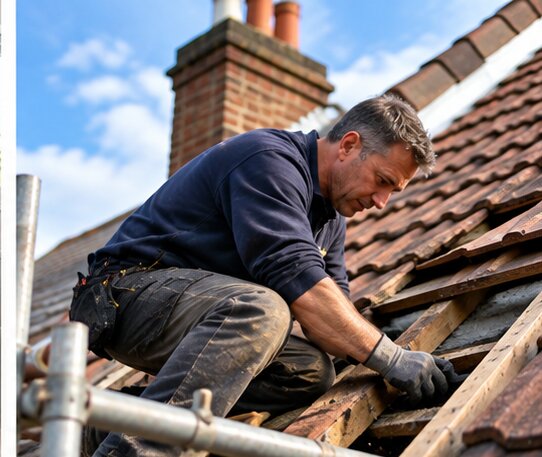
Are There Grants To Repair My Home If I Can’t Afford The Work?
Owning a home does not necessarily mean I have enough money to repair it.
A leaking roof, dangerous electrics, broken heating system or structural problem can require thousands of pounds of work, and these costs can be particularly difficult for somebody living on a low income.
There is no universal government grant that pays for every home repair I cannot afford.
However, councils and other organisations can sometimes provide financial assistance where work is essential, particularly for vulnerable or low-income homeowners.
The type of repair is crucial.
What Counts As An Essential Repair?
I would distinguish essential repairs from ordinary improvements.
Repairing a dangerous electrical system is very different from replacing a perfectly serviceable kitchen because I dislike its appearance.
Essential work might involve problems affecting the safety, structure or basic habitability of the home.
That could include serious roof leaks, unsafe wiring, major damp problems, essential heating repairs or work needed to address a hazard.
Cosmetic decorating and general modernisation are much less likely to attract public funding.
Can My Council Give Me A Home Repair Grant?
Possibly, although local policies vary considerably.
Councils can provide different forms of housing assistance to homeowners, including grants and loans in some areas.
One council may operate a specific home repair assistance programme while another provides support only in tightly defined circumstances.
This is why I would contact my own council rather than relying on somebody else’s experience.
I would ask specifically about financial assistance for essential home repairs, housing renewal and help for low-income or vulnerable homeowners.
Will I Have To Be On Benefits?
Not necessarily.
Some schemes use receipt of means-tested benefits as an eligibility condition, while others assess income, savings, age, disability or vulnerability more broadly.
I might therefore qualify even if I am not receiving Universal Credit.
Conversely, being on Universal Credit does not automatically mean that my council will pay for home repairs.
I would check the actual eligibility rules.
What If The Repair Is Related To Disability?
If the work is actually an adaptation required because somebody in the household is disabled, a Disabled Facilities Grant may be more appropriate than a general home repair scheme.
The distinction matters.
A Disabled Facilities Grant can help make a property suitable for a disabled person to live safely and independently.
This might include improving access, adapting bathroom facilities, providing appropriate heating controls or carrying out other necessary alterations.
The guidance on grants to make a home more accessible is therefore worth considering separately.
Could Energy-Efficiency Funding Help?
Sometimes a problem I think of as a home repair overlaps with energy efficiency.
For example, I may have inadequate heating, poor insulation or an inefficient energy system.
In England, qualifying low-income households in privately owned homes can potentially receive improvements through the Warm Homes: Local Grant.
That programme can provide insulation, solar panels, heat pumps and other approved measures.
It is not a general building-repair fund, so I could not use it simply to repair an unrelated roof problem.
However, it may solve some of the issues making my home cold and expensive to run.
What If My Boiler Is Broken?
Heating problems are worth investigating through energy-support schemes as well as general housing assistance.
Some households can qualify for heating improvements through energy-efficiency programmes.
I would therefore check grants for a new boiler and other heating support before arranging expensive work privately.
If I am in immediate financial crisis, I would also ask my council whether any crisis support is relevant.
I would not assume that every broken boiler qualifies for free replacement, but it is an area where assistance can exist.
Could A Charity Pay For Repairs?
Potentially.
Charitable funds can sometimes contribute towards essential household costs, particularly for people who meet specific eligibility criteria.
My previous occupation could be relevant. So could disability, illness, age, family circumstances or where I live.
A charity might not pay for an entire major renovation, but assistance towards a particular essential cost could still be valuable.
I would search for grants based on my circumstances rather than only searching for “home repair charity”.
What If I’m An Older Homeowner?
Some local schemes particularly target older or vulnerable homeowners who have limited resources with which to maintain their properties.
I would therefore tell the council about my complete circumstances.
There may also be home-improvement agencies or local services that help older or disabled people arrange necessary repairs.
Support may involve advice and practical assistance rather than simply handing me money.
That can still be valuable if I am unsure how to find a reliable contractor or manage a complicated repair.
What If I Rent My Home?
If I am a tenant, the situation is different.
I should not normally be paying for major structural repairs that are my landlord’s responsibility.
Landlords generally have obligations relating to the structure and exterior of rented homes, heating, water, sanitation and other essential elements.
I would report the problem to the landlord in writing and keep a record.
If serious hazards are not addressed, I may need advice from the council’s private-sector housing or environmental health service.
I would not take out a loan to repair somebody else’s property without obtaining proper advice first.
What About Leaseholders?
Leaseholders can face a more complicated position.
I might be responsible for costs through service charges even when the freeholder arranges the work.
Major works to roofs, external walls or communal areas can result in substantial bills.
Whether assistance is available will depend on the circumstances and the type of property.
I would examine the lease, speak to the freeholder or managing agent and obtain specialist housing advice if I was unsure about liability.
Can I Borrow From The Council?
Some councils offer loans rather than grants for essential repairs.
This may still be useful if commercial borrowing is unaffordable or unavailable.
However, I would make sure I understood how repayment works.
Some home-repair loans can be secured against the property or become repayable when the home is sold.
That is very different from a non-repayable grant.
I would never sign an agreement simply because the word “council” makes it sound risk-free.
Should I Start The Work Before Applying?
I would avoid doing so if I hope to obtain financial assistance.
Grant schemes frequently require approval before work starts.
If I hire a builder and complete the repair first, the council or funding organisation may have no ability to reimburse me afterwards.
An immediate safety emergency can obviously make waiting impossible, but where I have a choice I would check funding before committing myself.
Get Several Opinions On Major Work
If somebody tells me my home needs £20,000 of urgent repairs, I would normally want another professional opinion before committing to the work.
This is particularly important with roofs, damp, structural problems and major energy-efficiency projects.
Different contractors can recommend very different solutions.
I would want to understand the cause of the problem rather than simply paying for the first proposed treatment.
Grant funding does not make unnecessary work worthwhile.
Prioritise Safety
If I cannot afford everything that needs doing, I would prioritise work according to risk.
Dangerous electrics, serious structural problems and failures affecting basic heating, sanitation or weatherproofing may need to come before cosmetic defects.
I would explain those priorities clearly when approaching my council or a charity.
A photograph, survey, contractor’s report or quotation may help demonstrate the seriousness of the problem.
Help Exists, But It Is Local
Home repair assistance is one of those areas where it is difficult to give a single UK-wide answer.
Local councils have different policies and budgets, while the national schemes that do exist usually have specific purposes such as disability adaptations or energy efficiency.
That means I would search locally and describe the actual repair I need rather than simply asking whether there are “home improvement grants”.
I may find a grant, a low-cost loan, practical assistance or a specialist energy or disability scheme.
None is guaranteed. But if the repair is genuinely essential and I cannot afford it, I would investigate those options before assuming that taking out expensive commercial credit is my only choice.