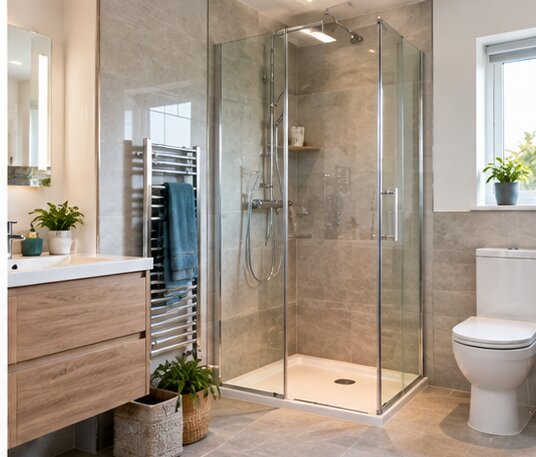
Can I Get A Grant For A New Bathroom?
Replacing a bathroom can cost thousands of pounds, particularly once plumbing, flooring, tiling and installation are included. If my existing bathroom is old or in poor condition, it is understandable to wonder whether a grant could pay for a new one.
In most circumstances, there is no general government grant simply because I would like a newer bathroom.
However, financial assistance can be available when bathroom work is necessary because of disability, accessibility, health or essential housing conditions.
The reason I need the work is therefore much more important than the age or appearance of the bathroom.
Can I Get A Grant Just Because My Bathroom Is Old?
Generally, I would not expect one.
Government and council grants are normally intended to meet particular social, health, housing or financial needs rather than fund ordinary home modernisation.
If my bathroom works properly but the suite is dated, the tiles are old-fashioned or I would prefer a more modern shower, I would usually need to pay for those improvements myself.
The situation changes if the bathroom is unsafe, unusable or unsuitable for somebody with a disability.
That can bring different forms of assistance into consideration.
What If I Need An Accessible Bathroom?
This is one of the clearest situations where grant assistance may be available.
Disabled Facilities Grants can help eligible disabled people make adaptations needed to live safely and independently at home.
Bathroom adaptations can include installing an accessible shower or making other changes that allow somebody to use washing and toilet facilities safely.
In some cases, the appropriate work could be substantial.
The important point is that the adaptation must be necessary and appropriate to meet the disabled person’s needs.
How Much Can A Disabled Facilities Grant Provide?
The maximum standard Disabled Facilities Grant differs across the UK.
In England, the maximum is currently £30,000.
In Wales, it is £36,000, while Northern Ireland has a maximum of £25,000.
Councils can sometimes provide additional assistance above these amounts under their local policies.
Scotland operates a different system for home adaptations.
I would therefore check the rules applying where I live rather than assuming one UK-wide maximum.
Is The Grant Means-Tested?
For adults, the amount I receive can depend on household income and savings.
The assessment generally considers household savings above a specified level as well as income.
Depending on my circumstances, I may need to contribute towards the work.
Different rules apply where the adaptation is for a disabled child under 18. Their parents’ income is not taken into account in the same way.
I would therefore not assume that earning a salary automatically prevents an application from succeeding.
What Sort Of Bathroom Work Could Be Covered?
The work needs to address the disabled person’s needs.
That might involve replacing a bath with an accessible shower, improving access to toilet facilities or altering the layout so that the room can be used safely.
In more complex situations, significant building work might be needed.
A grant can potentially contribute towards an extension where that is necessary to provide suitable facilities, although the council will assess what is reasonable and practicable.
The objective is independence and safety rather than creating a luxury bathroom.
Who Decides What I Need?
My local council will normally assess the application, and an occupational therapist may be involved in identifying what adaptations are necessary.
I would avoid commissioning my preferred bathroom design before that process has taken place.
The council may conclude that a different solution can meet my needs.
For example, I might initially imagine that an entirely new downstairs bathroom is required, while the assessment could identify a different adaptation.
I would keep an open mind until the needs assessment has been completed.
Can I Apply If I Rent?
Yes, potentially.
Disabled Facilities Grants are not restricted to owner-occupiers.
Tenants can potentially benefit, and landlords can also apply in relation to a disabled tenant.
I would speak to the council and my landlord before arranging any work.
If I live in social housing, my landlord may also have its own adaptations process.
Should I Start Work While Waiting?
I would not do this without discussing it with the council.
Starting work before a Disabled Facilities Grant has been approved can put funding at risk.
That is extremely important if I am relying on the grant to make the project affordable.
I would obtain approval first and follow the council’s process for quotations, contractors and payments.
What If My Bathroom Is In A Dangerous Condition?
If the issue is not disability but serious disrepair, I would look at local housing assistance.
Councils have powers and policies relating to housing conditions, although financial assistance for owner-occupiers varies substantially between areas.
Some councils operate loans or grants for essential repairs, particularly where vulnerable homeowners cannot afford necessary work.
A leaking bathroom causing structural damage is a different situation from wanting to replace an unfashionable suite.
I would explain the actual housing problem when contacting the council.
Could A Charity Help?
Potentially.
Charitable funds sometimes help with disability-related costs or essential home needs.
Eligibility could be connected to disability, illness, occupation, previous employment, age or financial hardship.
A charity is unlikely to fund an expensive designer bathroom simply because I cannot afford one.
However, assistance with essential adaptations or necessary household facilities may be possible in particular circumstances.
What If I’m On Universal Credit?
Universal Credit does not include a standard bathroom replacement grant.
Receiving Universal Credit could be relevant to a means-tested support scheme or demonstrate low income, but it does not create an automatic entitlement to a new bathroom.
For smaller essential costs, other forms of assistance may sometimes be available.
I would focus on why the bathroom work is necessary rather than trying to find a generic “Universal Credit bathroom grant”.
Could I Get Help With A Downstairs Bathroom?
Potentially, particularly if disability means I cannot safely access facilities upstairs.
A Disabled Facilities Grant can support substantial adaptations where they are necessary and appropriate.
That can include providing suitable bathroom facilities and, in some circumstances, building work.
However, I would need an assessment.
Wanting the convenience of a downstairs toilet is not the same as needing one because I cannot safely reach the existing bathroom.
What If The Work Costs More Than The Grant?
This can be a significant issue with complex adaptations.
Some councils can provide additional discretionary assistance, although local policies vary.
There may also be charitable funding or other resources that can contribute.
I would discuss the expected cost with the council early rather than assuming I will personally have to find every pound above the standard maximum.
I would also ask whether there are alternative designs capable of meeting the assessed need at a lower cost.
Separate Need From Preference
If I were investigating funding for a bathroom, I would make a clear distinction between what I need and what I would like.
A safe shower that I can use independently may be essential. Premium tiles, expensive taps and a particular style of vanity unit are preferences.
Grant-funded work is normally focused on the first category.
That does not mean the finished bathroom has to be unattractive. It simply means public funding has a defined purpose.
There is no broad scheme offering everybody a free bathroom renovation. However, where bathroom work is necessary because of disability or serious housing need, meaningful financial assistance can exist.
I would contact my council before arranging work and allow the assessed need, rather than the age of the bathroom, to guide the application.