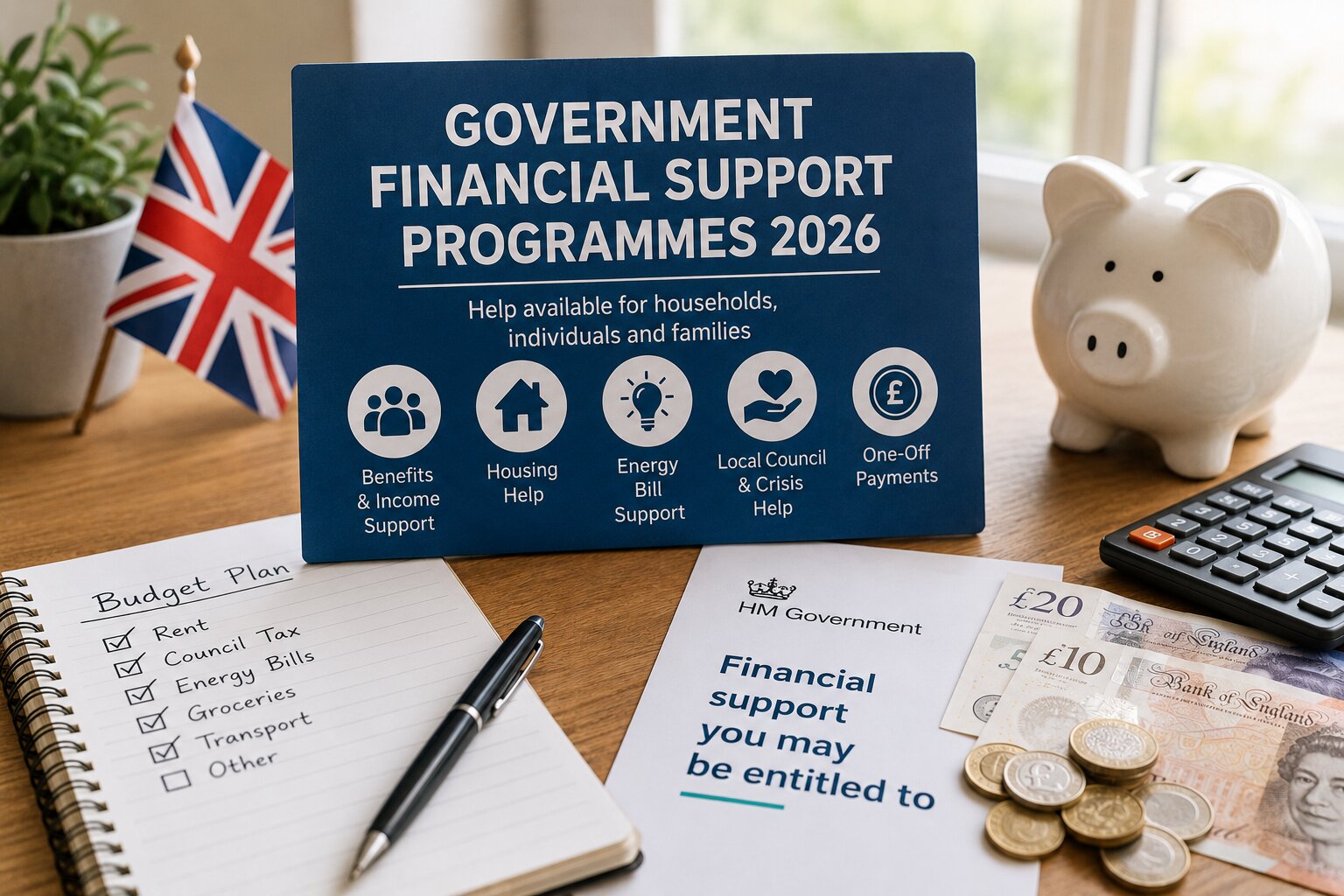
Government Financial Support Programmes 2026
Government financial support programmes in 2026 cover a wide range of help for households, individuals, pensioners, families, students, people on low incomes and those facing short-term financial difficulty.
Some support is paid through the benefits system. Some is handled by local councils. Other help may come through energy bill schemes, council tax reductions, winter payments, childcare support or one-off help during a financial crisis.
Because support can depend on where you live, your income, your household circumstances and the rules in place at the time, there is no single programme that applies to everyone. The best starting point is to understand the main types of help available and then check eligibility through official sources.
This guide explains the main forms of UK government financial support in 2026 and how households can approach the search for help in a practical way.
What Government Financial Support Can Include
Government financial support is not limited to one type of payment. It can include regular benefits, reductions on bills, crisis grants, winter heating help, support with childcare, housing-related help and local assistance with essential costs.
For some people, support may mean claiming a benefit such as Universal Credit or Pension Credit. For others, it may mean applying for council tax reduction, checking whether energy bill help is available, or asking a local council about emergency support.
It is also important to understand that not all support is paid directly into a bank account. Some help may be applied as a discount, credit, reduction or voucher. For example, energy-related support may reduce a bill rather than arrive as cash.
If you are unsure where to begin, our broader guide to financial help from the UK government explains the general starting points for people looking for support with living costs.
Benefits And Income Support
Benefits are one of the main ways the UK government provides financial support. They are usually designed to help people with living costs, low income, disability, caring responsibilities, housing costs, children or pension-age income.
Universal Credit is one of the best-known benefits for working-age people on a low income or out of work. It can include different elements depending on circumstances, such as housing, children, childcare or health-related needs.
Other benefits may include Pension Credit, disability-related benefits, Carer’s Allowance, Child Benefit, Housing Benefit in some circumstances, and support for people who are unable to work because of illness or disability.
Eligibility rules vary widely. A person’s income, savings, age, household, rent, children, health, caring role and work status may all affect what they can claim.
This is why benefits calculators are useful. They can help people estimate what support they might be entitled to before making a claim. They are not a final decision, but they can be a useful first step.
Pension Credit And Help For Older People
Pension Credit is an important form of support for people who have reached State Pension age and are on a lower income.
It can help top up weekly income and may also act as a gateway to other forms of help. In some cases, claiming Pension Credit can make a person eligible for additional support with heating costs, housing costs, council tax or other benefits.
Many people do not realise they may be eligible, especially if they have a small private pension, savings or own their home. These circumstances do not automatically rule someone out.
Older people who are struggling with everyday costs should not assume that State Pension is the only support available. It may be worth checking Pension Credit eligibility, especially if income is low or living costs are becoming difficult to manage.
Local Council Support
Local councils play a major role in delivering financial help, especially when people are facing immediate pressure.
In England, local crisis support can help with essential costs such as food, energy, water, household essentials or emergency needs. The exact support available can vary between councils, because local authorities often set their own application processes and priorities.
This means two people in different council areas may not have access to exactly the same help. One council may offer supermarket vouchers, another may provide direct help with energy costs, and another may focus on essential household items or emergency payments.
Local council support is often intended for people who need urgent or short-term help. It may not be a long-term income solution, but it can be important when a household is facing a sudden gap or crisis.
Anyone looking for government support for people facing money pressure should check their local council website as well as national benefit options.
Council Tax Reduction
Council tax can be a major household cost, so council tax reduction is worth checking for anyone on a low income.
Council Tax Reduction, sometimes called Council Tax Support, can reduce the amount of council tax a household has to pay. The scheme is run locally, so rules can vary between councils.
Eligibility may depend on income, savings, household size, benefits, age and other circumstances. Pension-age rules may be different from working-age rules.
Some councils may also have hardship schemes for people who are struggling to pay their bill, even if they do not qualify for full support.
Because council tax support is local, people usually need to apply through their own council rather than through a central government department.
Help With Energy Bills
Energy bills remain one of the most common reasons people look for government financial support.
In 2026, help with energy costs may include national schemes, local council support, supplier hardship help and winter-related payments for eligible households.
The Warm Home Discount is one of the best-known schemes. It is normally applied as a discount on an electricity bill for eligible households, rather than being paid directly as cash.
There may also be winter support for some older people, people on certain benefits or households affected by very cold weather. Eligibility can depend on age, income, benefit status and location.
People struggling with energy costs should also contact their supplier. Energy companies may be able to discuss payment plans, hardship funds or extra support for vulnerable customers.
For a more focused explanation, our article on government help with energy bills looks at the main types of support households may be able to check.
One-Off Payments And Crisis Help
Not all government financial support is ongoing. Some help is designed for one-off needs.
A one-off payment or short-term grant may be available when someone is facing a financial crisis, emergency expense or essential cost they cannot cover. This might relate to food, heating, replacing an essential appliance, moving home, caring responsibilities or an unexpected change in circumstances.
One-off help is often provided locally rather than nationally. That means the amount, eligibility rules and application process can vary.
It is important to understand that one-off payments are not usually guaranteed. They may depend on available funding, evidence of need and the rules in a particular area.
Our guide to sourcing one-off payments from the UK government explains how people can approach this type of support and where to look first.
Cost Of Living Support
Cost of living support has changed over time, and the type of help available in 2026 is not necessarily the same as in previous years.
Some earlier cost of living payments were linked to specific periods, benefits and qualifying dates. That means people should be careful when reading older information online, because a payment that existed in a previous year may no longer be open.
In 2026, support with living costs is more likely to involve a mixture of benefits, local council help, energy bill support, pensioner support and targeted schemes rather than one universal payment for everyone.
If you are researching UK government financial help, always check the date of the information you are reading. Older pages, social media posts and forum discussions may refer to schemes that have closed or changed.
Our article on UK cost of living payments explained looks at how these payments worked and what people should check now.
Childcare And Family Support
Families may be able to access different types of government help depending on income, work status, children’s ages and childcare arrangements.
Support may include help with childcare costs through Universal Credit, Tax-Free Childcare, Child Benefit or other family-related benefits. Some families may also be able to access free childcare hours, depending on the age of the child and the rules that apply.
Childcare support can be complicated because different schemes have different eligibility rules. A household may qualify for one type of support but not another.
Parents should check carefully before making childcare decisions, especially if they are starting work, increasing hours or changing providers.
Housing-Related Support
Housing costs are another major area where government support may be available.
For many working-age people, help with rent is included as part of Universal Credit. Some people may still receive Housing Benefit, depending on age, accommodation type or other circumstances.
Local councils may also offer Discretionary Housing Payments in some cases where people need extra help with housing costs. This is usually for people who already receive housing support but still face a shortfall.
Support with rent, deposits, homelessness prevention or emergency accommodation may also be available through local councils, depending on circumstances.
Anyone at risk of losing their home should seek advice quickly, because housing support can be time-sensitive.
How To Check What Support You May Get
The most practical way to check government financial support is to work through the main categories one by one.
Start with benefits. Use a benefits calculator or check official guidance to see whether you may qualify for regular support.
Then check local council help. This includes council tax reduction, crisis support, local welfare help and housing-related assistance.
Next, check bill-specific support. Energy, water, childcare and housing costs may each have separate routes for help.
Finally, check whether your circumstances create extra eligibility. This may include being a pensioner, disabled person, carer, parent, student, tenant, unemployed person, low-paid worker or someone facing a crisis.
Keeping notes can help. Write down what you have checked, what evidence is needed and any deadlines or reference numbers.
Avoiding Scams And Outdated Information
Financial support searches can attract scams, especially when people are looking for urgent help.
Be cautious of messages claiming you are guaranteed a payment, especially if they ask for bank details, passwords, fees or personal documents through an unofficial link.
Government departments, councils and recognised organisations will not usually ask people to pay a fee to claim basic financial support.
Outdated information is another common problem. Support schemes can close, reopen, change names or move from national to local delivery. Always check the publication date and confirm details through official sources where possible.
Sharing Clear Finance Information
Clear, careful financial information is important because many people find support systems difficult to understand.
Commerce Grants publishes guides on grants, funding, business support, personal finance and government help for households. Writers with relevant experience who want to contribute a finance article can review our Write For Us Finance page for more information about suitable topics.
Good finance content should help readers understand their options without making unrealistic promises or giving direct personal advice.
Conclusion
Government financial support programmes in 2026 can include benefits, local crisis help, council tax reduction, energy bill support, pensioner support, childcare help, housing-related assistance and one-off payments.
The right support depends on personal circumstances, location and current eligibility rules. Some help is national, while other support is delivered through local councils or specific schemes.
The best approach is to check benefits first, then local council support, then help with specific costs such as energy, housing, childcare or council tax.
If you are facing financial pressure, do not rely only on one route. You may need to check several different types of help before finding the support that applies to your situation.