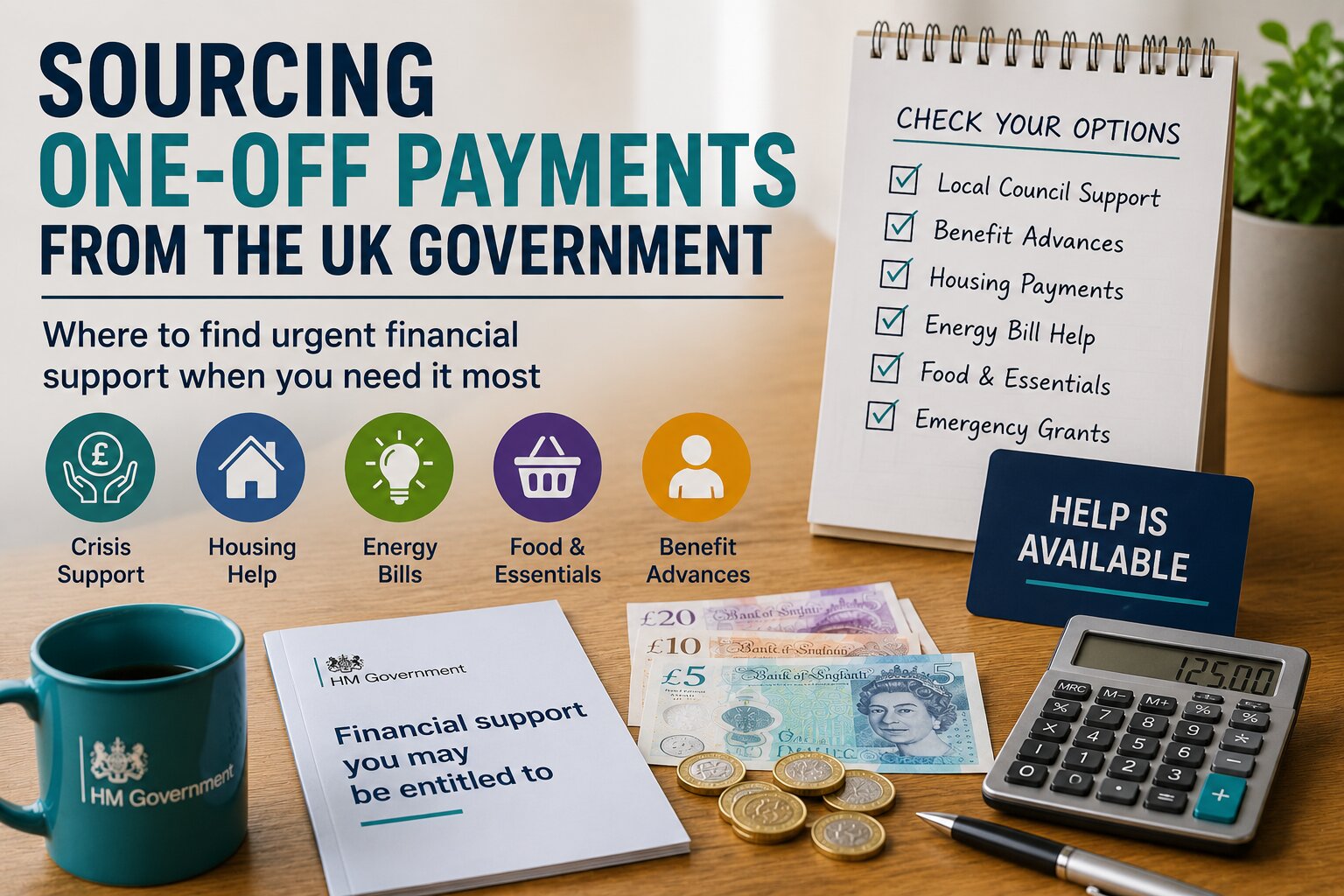
Sourcing One-Off Payments From The UK Government
Sourcing one-off payments from the UK government can be confusing because there is no single payment that applies to every household, person or situation.
Some one-off help is offered through local councils. Some is linked to benefits. Some may be available for housing costs, energy bills, food, essential items, moving costs or emergency needs. In other cases, the support may not be a cash payment at all. It may be a voucher, bill credit, grant, loan, goods-in-kind or payment made directly to a landlord or supplier.
The most important thing to understand is that one-off government help is usually based on need, eligibility and available funding. It is rarely automatic unless it is part of a specific national scheme.
This guide explains the main routes to check if you are looking for one-off financial support in the UK.
What Counts As A One-Off Government Payment?
A one-off government payment is usually short-term financial help designed to deal with a specific cost or crisis.
It might help with food, energy bills, water bills, rent shortfalls, essential household items, moving costs, emergency travel, school holiday support or other urgent needs.
However, the phrase “one-off payment” can mean different things depending on the scheme. In some cases, it means money paid into a bank account. In others, it may mean a supermarket voucher, fuel voucher, direct bill credit, rent account credit or support provided through a local organisation.
Some one-off help does not have to be repaid. Other support, such as a benefit advance or Budgeting Loan, usually does need to be repaid through future benefit payments.
Before applying, check whether the support is a grant, payment, voucher, credit or loan.
Start With Your Local Council
For many people, the first place to check is the local council.
Councils can provide short-term help for people who are vulnerable or unable to pay for essentials. In England, this support is now known as the Crisis and Resilience Fund. It is intended to help people facing financial difficulty and can cover essential costs such as food, energy, water, housing and household items.
The exact support available depends on the council. Some councils may provide cash support, while others may offer vouchers, direct payments, referrals to local charities or help with specific bills.
This means the help available in one council area may be different from the help available somewhere else. A person in Manchester, Birmingham, Bristol or Leeds may find different rules, different forms and different application processes.
If you are looking for financial help from the UK government, local council support should usually be one of the first options to check.
Crisis And Resilience Fund Payments
The Crisis and Resilience Fund is designed to help people facing financial shocks and to support longer-term financial resilience.
A crisis payment may be available when someone cannot afford essentials or is facing a short-term emergency. This could include help with food, utilities, essential household goods or other urgent costs.
Government guidance encourages councils to take a “cash-first” approach where appropriate. This means cash support may be prioritised when it best meets the person’s needs. However, cash-first does not mean cash-only. Councils may still provide vouchers, goods or other forms of help where that is more suitable.
The fund can also support housing-related needs, including situations where someone has a shortfall between housing support and actual rent.
Because councils decide how to run their own schemes, applicants should check the local rules carefully. Some councils may limit how often a household can apply. Others may ask for evidence of income, rent, bills, savings or the crisis that has created the need.
Housing Payments And Rent Shortfalls
One-off housing help may be available if you are struggling with rent or other housing costs.
In England, housing-related support now sits within the Crisis and Resilience Fund. In Wales and Scotland, Discretionary Housing Payments may still apply through local councils.
Housing support may help with:
- rent shortfalls
- rent deposits
- rent in advance
- moving costs
- housing-related crisis costs
- shortfalls linked to benefit rules or local rent levels
This type of help is usually discretionary. That means the council decides whether to award support, how much to pay and how long the help should last.
A housing payment may be paid directly to a landlord, credited to a rent account or paid in another way depending on the council’s rules.
If you are at risk of falling behind on rent, it is important to ask for help early. Waiting until arrears become serious can make the situation harder to resolve.
Universal Credit Advances
If you claim Universal Credit, you may be able to apply for an advance or other financial support in some circumstances.
This can include an advance on your first payment, an advance for unexpected costs, help when your payment has changed or a hardship payment if your payment has been stopped or reduced.
Universal Credit advances are not the same as grants. They usually have to be repaid through future Universal Credit payments. This means they can help with an immediate gap but may reduce the amount you receive later.
An advance may be useful if you need urgent help, but it is important to consider the repayment impact before applying.
If you are already struggling with monthly costs, taking an advance could make future budgeting harder unless you understand the repayment terms.
Budgeting Loans And Budgeting Advances
Budgeting Loans and Budgeting Advances can help some people on benefits with one-off essential costs.
These may be used for things such as household items, clothing, moving costs, rent in advance, maintenance, travel, funeral expenses or other necessary costs.
Whether you can apply depends on the benefits you receive and your circumstances. Budgeting Loans are normally linked to certain legacy benefits, while Budgeting Advances are linked to Universal Credit.
These are usually loans, not grants. They are normally interest-free, but they still have to be paid back.
Because of this, they should be treated as short-term help rather than free money. If you are considering this route, check how repayments would affect your future income.
One-Off Help With Energy Bills
Energy bills are one of the most common reasons people look for emergency support.
One-off help with energy costs may come from several routes. Your local council may be able to help through crisis support. Your energy supplier may have a hardship fund or be able to offer a payment plan. Some people may qualify for wider schemes such as the Warm Home Discount or winter-related support.
If you use a prepayment meter and cannot afford to top up, you may be able to ask your supplier about temporary credit. Local organisations may also be able to help with fuel vouchers in some circumstances.
For a more detailed guide, see our article on government help with energy bills, which explains the main support routes households can check.
One-Off Payments For Essential Items
Some councils may help with essential household items when someone is facing hardship.
This could include support for a fridge, cooker, bed, bedding, clothing, school essentials, white goods or basic furniture. The help may be provided as money, vouchers, goods-in-kind or referral to a local partner organisation.
Support for essential items is usually needs-based. Councils may ask why the item is needed, whether there are children or vulnerable people in the household, and whether the applicant has any other way to meet the cost.
This kind of help is not guaranteed, but it may be worth checking if an essential item has broken, is missing after a move, or is needed to keep the household safe and functioning.
Food And School Holiday Support
One-off help may also be available for food and school holiday costs.
Some councils provide food vouchers, supermarket support or referrals to local food organisations. Families with children may also find that councils or schools provide holiday-related support during certain periods.
The rules vary by area. Some support may be linked to free school meals, low income, vulnerability or local hardship criteria.
If you need food urgently, local councils, advice agencies, schools, health visitors, children’s centres or community organisations may be able to point you toward emergency help.
Scotland, Wales And Northern Ireland
One-off support is not exactly the same across the UK.
In Scotland, people may be able to check the Scottish Welfare Fund for crisis grants or community care grants. In Wales, the Discretionary Assistance Fund may help with urgent costs or essential items.
Northern Ireland has its own support routes and welfare arrangements, so households should check official Northern Ireland guidance or local advice services.
Because schemes differ by nation, it is important not to rely only on England-based information if you live elsewhere in the UK.
How To Prepare Before Applying
Before applying for one-off support, gather the information you may need.
This could include:
- proof of identity
- address details
- income information
- benefit details
- bank statements
- rent or mortgage information
- utility bills
- evidence of the emergency
- details of household members
- information about savings or debts
Not every scheme will ask for all of this, but having documents ready can make the process easier.
It also helps to explain the situation clearly. Instead of only saying “I need money”, explain what the cost is, why it is urgent, what has caused the shortfall and what support you are asking for.
For broader background, our guide to help available from the UK government explains how different types of support can fit together.
Avoiding Scams And False Promises
People searching for one-off payments are often in urgent situations, which can make them more vulnerable to scams.
Be careful with messages that promise guaranteed government money, especially if they ask you to click a link, pay a fee, give bank details or upload documents through an unofficial website.
Government and council support should be checked through official sources. If you receive a message about a payment you were not expecting, go directly to the relevant government, council or supplier website rather than using a link in the message.
Also be cautious of outdated information. A one-off payment that was available in a previous year may have closed. This is especially true for older cost of living payments, which were linked to specific dates and payment periods.
Our article on UK cost of living payments explained gives more detail on how previous payments worked and why current support should be checked separately.
Clear Finance Guidance For Readers
One-off government support can be difficult to understand because the rules vary by location, benefit status and household need.
Commerce Grants publishes clear information on grants, government help, personal finance, household support and cost-of-living topics. Writers who want to share clear finance guidance with readers can review our Write For Us Finance page for contributor information.
Good financial information should help people understand where to check next without making promises about payments they may not receive.
Conclusion
Sourcing one-off payments from the UK government usually means checking several possible routes rather than looking for one universal scheme.
The most relevant options may include local council crisis support, Crisis and Resilience Fund payments, housing payments, Universal Credit advances, Budgeting Loans, energy bill support, school holiday help and devolved support schemes in Scotland, Wales or Northern Ireland.
Some help may be a grant or payment that does not need to be repaid. Other help may be a loan or advance that reduces future benefit income. Some support may be provided as vouchers, goods, bill credits or direct payments to a landlord or supplier.
If you need urgent help, start with your local council, check your benefit options, contact relevant bill providers and use official sources. One-off help is not guaranteed, but there may be support available depending on your circumstances and where you live.