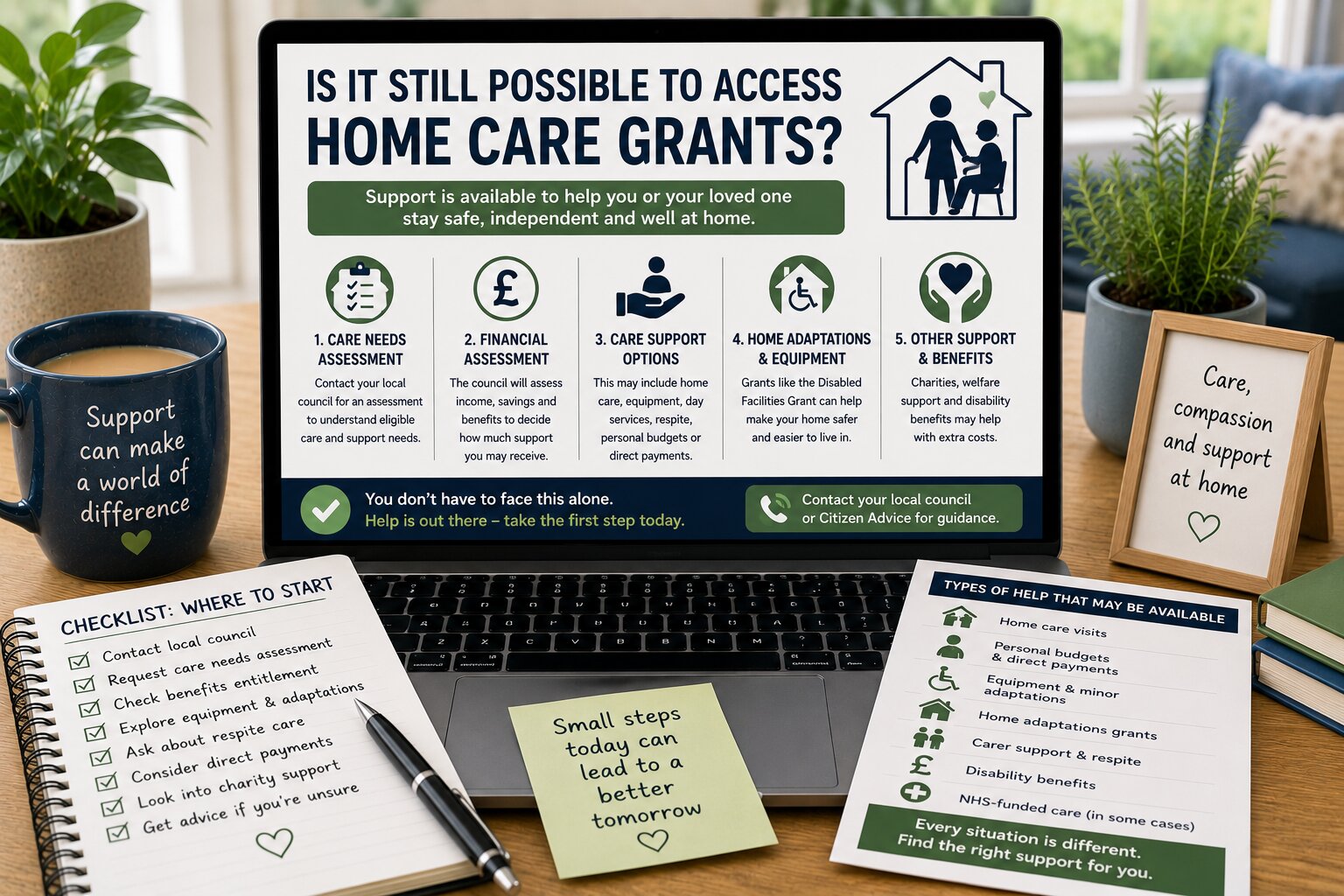
Is It Still Possible To Access Home Care Grants?
Home care can become necessary when someone is older, disabled, recovering from illness, living with a long-term condition, or finding everyday tasks difficult. Families often search for home care grants because paid care can be expensive, and many people want to remain safely in their own home for as long as possible.
The difficulty is that “home care grant” is not always the phrase used by councils, the NHS or charities. In many cases, help is provided through care assessments, personal budgets, direct payments, disability benefits, home adaptation grants, local support schemes or charitable funds rather than a simple cash grant labelled for home care.
So, is it still possible to access home care grants? In some situations, yes. But it is usually better to think in terms of care funding, assessed support and practical help at home rather than expecting one straightforward grant that covers everything.
What Do People Mean By Home Care Grants?
When people talk about home care grants, they may mean several different things. Some are looking for help paying for carers who visit the home. Others need equipment, adaptations, alarms, mobility aids, cleaning help, meal support, respite care or changes to make a home safer.
Some people are searching on behalf of an older parent. Others are disabled adults trying to live independently, carers needing a break, or families supporting someone after a hospital discharge.
Because the phrase is broad, the right route depends on the need. Help with personal care is usually handled differently from help with a stairlift. A grab rail is different from a home carer. A cleaning service is different from a disability adaptation. A carer’s break is different from ongoing care funding.
The first step is to define the type of help needed clearly.
Start With A Care Needs Assessment
For most people, the starting point is a care needs assessment from the local council or local social services department. This assessment looks at what support a person needs to manage daily life.
The assessment may consider whether the person can wash, dress, prepare food, use the toilet, move around safely, maintain their home, take part in daily activities, stay safe, manage relationships or avoid isolation.
If the council decides the person has eligible care needs, it may prepare a care and support plan. This plan sets out what help is needed and how those needs might be met.
The support might include home care visits, equipment, adaptations, day services, help with meals, direct payments, support for carers or other forms of assistance. It will not always be free, because a financial assessment may decide whether the person needs to contribute towards the cost.
This is one of the main reasons why home care funding is not the same as a simple grant.
Financial Assessments And Paying For Care
After a needs assessment, the council may carry out a financial assessment. This looks at income, savings, capital and sometimes certain benefits to decide whether the person should contribute towards their care costs.
If the person qualifies for council-funded support, the council may pay some or all of the cost. If they have higher income or savings, they may need to pay more themselves. The rules can be complicated, and they differ depending on the type of care and where the person lives.
It is important not to assume that low income automatically means every care cost will be covered, or that owning a home always prevents support. For care at home, the value of the home is usually treated differently from residential care.
Anyone unsure should ask the council for a clear explanation of the financial assessment and how the contribution has been calculated.
For households already under financial pressure, it may also be worth reviewing free grants for low income families, especially where the issue includes essential household costs as well as care needs.
Personal Budgets And Direct Payments
If a council agrees that someone has eligible care needs, it may allocate a personal budget. This is the amount identified to meet the person’s assessed care and support needs.
In some cases, the money can be provided as direct payments. Direct payments allow the person, or someone acting for them, to arrange certain support themselves rather than having all services arranged directly by the council.
This can give more control, but it also brings responsibilities. Direct payments may need to be used only for agreed care needs, records may need to be kept, and the person may need to manage payments, invoices or employment responsibilities if they hire a personal assistant.
Direct payments are not general spending money. They are designed to meet assessed care needs in a way that has been agreed through the care plan.
Help With Home Adaptations
Some people searching for home care grants actually need home adaptations. These are changes to the property that help a disabled person live more safely and independently.
A Disabled Facilities Grant may help with adaptations such as ramps, stairlifts, accessible bathrooms, wider doors, heating improvements or changes that make it easier to use essential rooms. The grant is usually arranged through the local council and is based on disability-related need.
This is not a grant for ordinary home improvement. The work must usually be necessary and appropriate for the disabled person and reasonable for the property. There may also be a means test, although rules can differ for children.
Disabled Facilities Grants are available in England, Wales and Northern Ireland. Scotland has different arrangements for equipment and adaptations.
This topic overlaps with government grants for housing, because many housing grants are aimed at safety, accessibility and essential living conditions rather than general renovation.
Equipment And Minor Adaptations
Not every support need requires a major grant. Some people may be able to access equipment or minor adaptations through the council, NHS services or community equipment services.
This might include grab rails, raised toilet seats, shower chairs, walking aids, bed rails, perching stools, key safes, pressure-relief equipment or other practical items.
In some cases, small aids and adaptations may be provided more quickly than larger works. An occupational therapist may assess the person’s needs and recommend suitable equipment.
The right route will depend on the local system. Some support may come through social care, some through health services, and some through joint local equipment services.
Attendance Allowance, PIP And Disability Benefits
Disability benefits can help people meet the extra costs of illness or disability. They are not home care grants, but they may help someone pay for support, equipment, transport, supervision or other needs.
Attendance Allowance may be available to people over State Pension age who need help with personal care or supervision because of illness or disability. Personal Independence Payment may be relevant for working-age adults, while Disability Living Allowance or Child Disability Payment may apply in some child-related situations depending on where the person lives.
These benefits are not usually means-tested in the same way as many income benefits. They are based on care, mobility or supervision needs, depending on the benefit.
A successful disability benefit claim can sometimes increase access to other support or improve household income. However, applying can be detailed, and it may be helpful to get advice from Citizens Advice, Age UK, a disability charity or a welfare rights service.
NHS Continuing Healthcare And Health-Funded Support
Some people with significant health needs may be assessed for NHS Continuing Healthcare. This is a package of care arranged and funded by the NHS for adults with a primary health need.
This is not a general home care grant, and eligibility is limited. It is usually considered where someone has complex, intense or unpredictable health-related care needs.
There may also be support after hospital discharge, reablement services or short-term rehabilitation support. These services can help someone regain independence and reduce the need for longer-term care.
Families should ask hospital discharge teams, GPs, community nurses or social care teams if they believe health-funded support may be relevant.
Charitable Grants For Care At Home
Charities may help with some care-related costs, although they rarely replace full council or NHS funding. Support may be available for equipment, respite breaks, mobility aids, home safety items, emergency costs, specialist devices or practical support.
Some charities focus on older people. Others support disabled people, carers, people with particular medical conditions, veterans, former workers in certain industries or people living in a specific local area.
Occupational benevolent funds can also be relevant. A person may qualify because they worked in a certain sector, or because a partner or family member had an occupational connection.
Grant search tools can help identify suitable charities, but applications often require evidence. This might include income details, medical evidence, care assessments, benefit awards or a supporting letter from a professional.
Support For Carers
Home care is not only about the person receiving care. Unpaid carers may also need support. This can include carers’ assessments, respite breaks, training, emotional support, equipment, emergency planning or help balancing work and caring responsibilities.
A carer’s assessment from the local council can identify what support the carer may need. This is separate from the cared-for person’s needs assessment.
Depending on the situation, support could include a short break, practical help, advice, direct payments or referral to local carers’ services.
Carers may also want to check benefit entitlement, including Carer’s Allowance or the carer element of Universal Credit where relevant. Rules can be detailed, especially where work, study, pensions or other benefits are involved.
Local Welfare And Hardship Support
Where care needs are part of a wider household crisis, local welfare or hardship support may be relevant. For example, a household may need help with heating, food, a broken appliance, essential furniture, bedding, transport to appointments or setting up a safer home environment.
This type of support is not usually described as a home care grant, but it may still help someone remain at home more safely.
The rules vary by council and by UK nation. Some schemes focus on emergencies, while others help with essential household items or crisis prevention.
People on Universal Credit or low income may also want to consider whether support linked to decorating grants on Universal Credit is really about safety, flooring, warmth or liveability rather than cosmetic decorating.
Housing Association And Landlord Support
Social landlords and housing associations may offer tenancy support, welfare advice, hardship funds, adaptations teams or referrals to local services. Some may help with minor adaptations, safety improvements or support to maintain a tenancy.
Tenants should contact their landlord if their home is becoming unsuitable because of disability, mobility issues or care needs. The landlord may need to work with the council, occupational therapists or adaptations services.
Private tenants should also seek advice before making changes to the property, as landlord permission may be needed for adaptations or fixtures.
Where the property itself is unsafe, damp, unsuitable or in serious disrepair, the issue may be a housing rights matter rather than a grant application.
Home Care Grants Versus Home Improvement Grants
It is easy to confuse care support with home improvement support. A home care grant would usually relate to care needs, independence, disability, safety or support at home. A home improvement grant might relate to repairs, energy efficiency, adaptations or housing conditions.
For example, a stairlift may be linked to disability and independence. Insulation may be linked to energy efficiency. Roof repairs may be linked to housing condition. A carer visiting daily is a social care service. These may all help someone remain at home, but they are funded through different routes.
Applicants should avoid using one broad phrase for everything. A more specific request is usually more effective.
How To Apply For Help
The best first step is to contact the local council and request a care needs assessment. If adaptations are needed, ask whether an occupational therapy assessment or Disabled Facilities Grant route is appropriate.
If the issue is health-related, speak to the GP, hospital discharge team, community nurse or NHS service involved. If the person is older, Age UK or a local advice service may help explain options. If the person is disabled, a specialist disability charity may be useful.
Before applying for charitable grants, gather evidence. This may include care assessments, benefit letters, bank statements, medical evidence, invoices, quotes, photographs, occupational therapist recommendations or support letters.
A clear application should explain the need, why it matters, why the person cannot fund it themselves, and how the support would help them remain safe or independent at home.
Common Mistakes To Avoid
One mistake is searching only for “home care grants” and missing the real route. The right answer may be a care assessment, direct payment, disability benefit, home adaptation grant, NHS assessment or charity fund.
Another mistake is assuming care will be free. Some people receive funded support, but many are asked to contribute after a financial assessment.
A third mistake is waiting too long. Care needs often build gradually, but support can take time to assess and arrange. It is better to ask for help before the situation becomes unsafe.
Applicants should also be cautious of websites suggesting that large government care grants are easy to claim. Genuine care funding is usually assessed and evidence-based.
Commerce Grants also welcomes people who can share practical care funding guidance for readers trying to understand home support, disability adaptations and household grants.
Conclusion
It is still possible to access support that helps with home care, but it is not usually offered as one simple “home care grant”. The main routes are care needs assessments, financial assessments, personal budgets, direct payments, disability benefits, Disabled Facilities Grants, NHS-funded care in limited cases, charity grants and local welfare support.
The best approach is to define the need clearly. Help with a paid carer, home adaptations, equipment, respite, safety, mobility or essential household items may each follow a different route.
Anyone needing care at home should start with the local council, seek a needs assessment, check benefit entitlement and explore specialist charities where appropriate. The support may not always be called a grant, but it can still make a significant difference to safety, independence and quality of life at home.