The UK Economic Growth Rate Through History
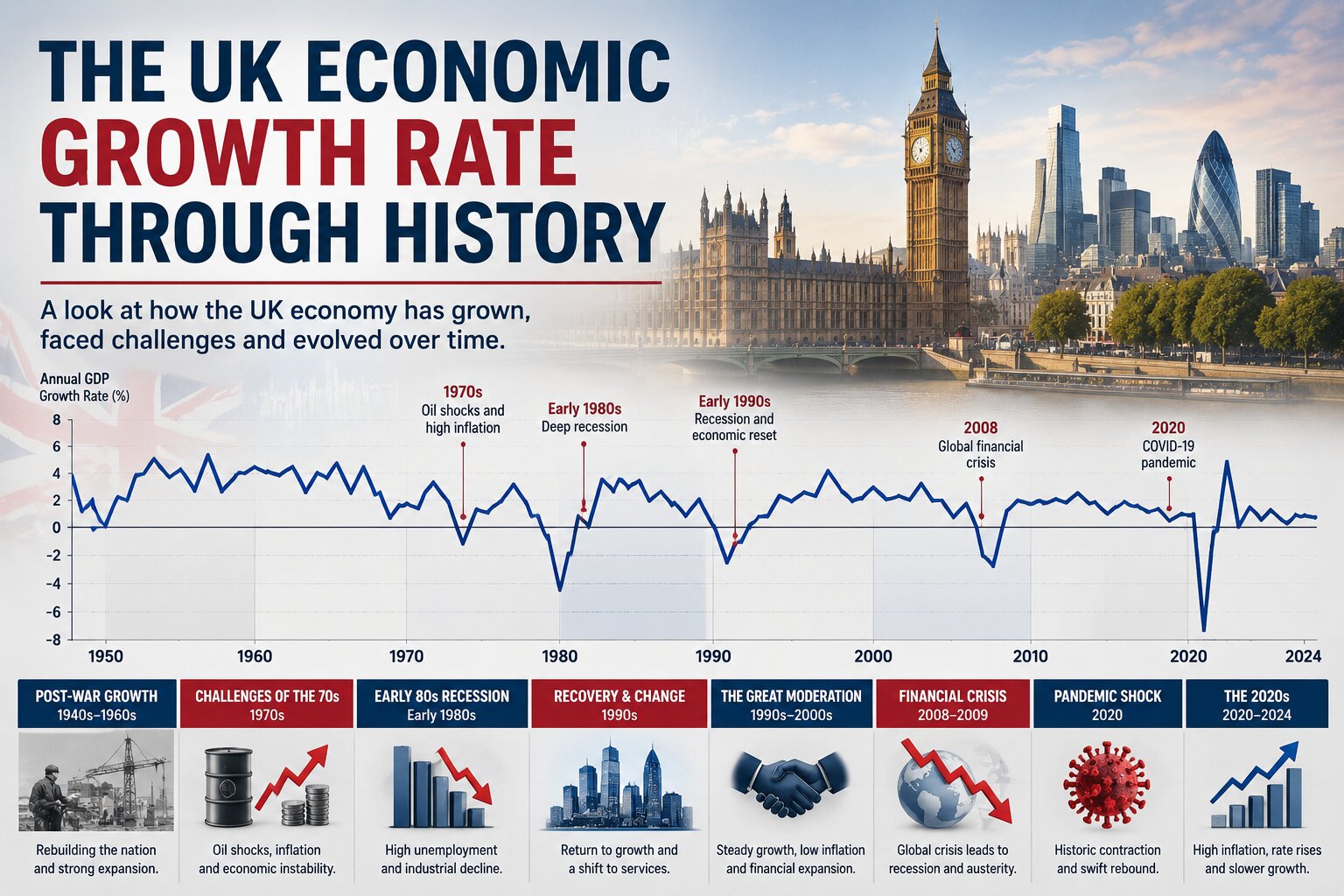
The UK economic growth rate has changed significantly through history. Periods of strong expansion have often been followed by slowdowns, recessions, recoveries and new economic challenges.
When people talk about the UK economy growing, they are usually referring to changes in gross domestic product, or GDP. GDP measures the value of goods and services produced in the economy. If GDP rises, the economy is growing. If GDP falls, the economy is shrinking.
Looking at the UK economic growth rate through history helps put today’s headlines into context. A small quarterly rise may sound weak, but it may be more meaningful after a period of stagnation. A sharp fall may look dramatic, but it may be linked to an unusual event such as a financial crisis or pandemic.
Economic growth does not explain everything about living standards, wages or household pressure. However, it is one of the most important indicators used to understand the direction of the economy. If you need insights into the basics of economics terminology, then our guide is a good place to start.
What Is The Economic Growth Rate?
The economic growth rate measures how much the economy has grown or shrunk over a period of time.
In the UK, this is usually measured by changes in real GDP. Real GDP adjusts for inflation, which makes it easier to see whether the economy is producing more goods and services rather than simply recording higher prices.
Growth is often reported monthly, quarterly or annually. For example, the economy might grow by 0.2% in a month, 0.5% over a quarter or 1.4% over a year.
A positive growth rate means output has increased. A negative growth rate means output has fallen.
Small changes matter because the UK economy is large. Even a modest percentage change can represent a significant change in economic activity across businesses, households, public services and government finances.
For a simpler explanation of the underlying measure, see our guide to UK GDP explained and what it can mean for households and businesses.
Why Historical Growth Matters
Historical growth rates help show how the economy has changed over time.
A single GDP figure can be useful, but it does not explain whether the economy is performing unusually well, unusually badly or broadly in line with past trends. Long-term comparisons help show whether growth is strong, weak, stable or volatile.
For example, the UK economy has experienced post-war rebuilding, industrial change, inflation shocks, recessions, financial deregulation, globalisation, the financial crisis, Brexit-related uncertainty, the pandemic and a period of high inflation.
Each of these periods affected growth in different ways.
Historical growth also matters because governments often make promises about improving the economy. To understand those promises, it helps to know what growth has looked like in previous decades.
Post-War Growth And Reconstruction
After the Second World War, the UK economy entered a long period of rebuilding and expansion.
The late 1940s, 1950s and 1960s were shaped by post-war reconstruction, rising public services, industrial production, increased consumer spending and a changing labour market. This period is often associated with stronger and more stable growth than many later decades.
Living standards generally improved over time, though the economy still faced challenges, including balance of payments pressures, industrial disputes and changes in global trade.
The structure of the economy was also different. Manufacturing and heavy industry played a larger role than they do today, while services were smaller as a share of national output.
This matters because UK growth history is not just about whether GDP rose or fell. It is also about how the economy itself changed.
The 1970s: Inflation, Oil Shocks And Instability
The 1970s were a more difficult period for the UK economy.
Growth became less stable, and the country faced high inflation, oil price shocks, industrial unrest and pressure on public finances. The economy was affected by global energy problems as well as domestic challenges.
This was a period when the idea of “stagflation” became important. Stagflation means weak or stagnant economic growth combined with high inflation. It is especially difficult because the usual policy response to one problem can make the other worse.
For households, high inflation reduced purchasing power. For businesses, uncertainty made planning more difficult. For policymakers, the challenge was how to control prices without damaging output and employment too heavily.
The 1970s remain important in UK economic history because they showed that growth could be disrupted by both domestic and global shocks.
The Early 1980s Recession
The UK experienced a severe recession in the early 1980s.
This period was marked by high unemployment, industrial decline and major changes in economic policy. Traditional manufacturing areas were hit particularly hard, while parts of the economy began shifting more heavily toward services and finance.
The recession reflected several pressures, including tight monetary policy used to control inflation, structural change in industry and weak demand in parts of the economy.
Although inflation eventually came down and growth returned, the effects were uneven. Some regions and communities experienced long-lasting economic damage.
This period is a reminder that national growth figures can hide very different local experiences. The economy may recover overall while some places continue to struggle.
Late 1980s Growth And The Early 1990s Downturn
The second half of the 1980s saw stronger growth, helped by rising consumer spending, financial deregulation, higher credit use and a booming housing market.
However, this expansion was followed by another downturn in the early 1990s. The recession affected households and businesses through falling house prices, rising unemployment, high interest rates and reduced confidence.
The early 1990s also included Black Wednesday in 1992, when the UK withdrew from the European Exchange Rate Mechanism. This became one of the most notable economic and political events of the decade.
After the recession, growth gradually returned. The economy then moved into a long period of expansion that would last until the financial crisis.
The Great Moderation
From the early 1990s to 2008, the UK experienced a long period of relatively steady growth.
This period is often described as part of the “Great Moderation”, when economic growth and inflation appeared more stable than in earlier decades. The UK saw many years of expansion, supported by services growth, financial sector strength, rising employment and household borrowing.
For many businesses, this period felt more predictable than the economic turbulence of the 1970s and early 1980s. Inflation was lower, interest rate policy became more established, and the Bank of England gained operational independence in 1997.
However, stability also created risks. Rising credit, high house prices and financial sector expansion left the economy vulnerable when global financial conditions changed.
The long expansion ended with the global financial crisis.
The 2008 Financial Crisis And Recession
The financial crisis created one of the most serious downturns in modern UK economic history.
Banks came under severe pressure, credit conditions tightened and confidence fell sharply. The UK economy contracted as businesses reduced investment, households cut spending and financial markets became unstable.
The recession affected employment, wages, public finances and business activity. Government borrowing rose as tax receipts weakened and support measures increased.
The recovery from the financial crisis was slower than many previous recoveries. Although GDP eventually returned to growth, productivity growth remained weak, and many households experienced a long period of squeezed living standards.
This period is central to understanding modern UK economic performance because it changed the path of growth for many years.
The 2010s: Recovery With Weak Productivity
The 2010s were marked by economic recovery, but also by persistent concerns about productivity.
Productivity measures how much output is produced for each hour worked or each worker. When productivity grows strongly, wages and living standards are more likely to rise over time. When productivity is weak, growth can feel less meaningful for households.
The UK economy did grow during much of the 2010s, but growth was often described as modest compared with earlier expansions. Wage growth was also weak for part of the period, especially after inflation was taken into account.
This helped explain why some people did not feel much better off even when GDP was rising.
The 2010s also included the Brexit referendum in 2016 and the uncertainty that followed. This affected business investment, trade expectations and long-term economic forecasts.
The Pandemic Shock
The COVID-19 pandemic caused an extraordinary fall in UK economic output in 2020.
Restrictions, business closures, reduced travel, lower consumer activity and disruption across many sectors led to a historic contraction. Some sectors, such as hospitality, aviation, retail and leisure, were especially affected.
The economy then rebounded as restrictions eased and activity resumed. However, the recovery was uneven. Some businesses reopened quickly, while others faced labour shortages, supply chain disruption, debt, changed customer behaviour or higher costs.
The pandemic also affected public finances, with major government support programmes introduced to protect jobs, businesses and household incomes.
This period stands out in growth history because the fall and rebound were shaped by public health restrictions rather than a normal business cycle.
The 2020s: Inflation, Rates And Slow Growth
After the pandemic rebound, the UK economy faced new challenges.
High inflation, rising interest rates, energy price shocks, supply pressures and weak real income growth all affected households and businesses. Many people experienced higher bills even when the economy was not technically in a deep recession.
Growth in the early and mid-2020s has generally been weaker than the strongest periods of post-war expansion. The economy has also faced questions about productivity, business investment, public service pressure and regional inequality.
Recent GDP figures have shown modest growth rather than rapid expansion. This means even positive growth rates may not feel strong in everyday life if wages, rents, energy bills or borrowing costs remain under pressure.
For readers trying to understand these wider forces, it can help to read about what macroeconomics means, because growth is closely linked with inflation, employment, interest rates and public spending. Have your own input on these subjects? We welcome economics and finance guest posts.
Growth Rates And Living Standards
Economic growth is important, but it is not the same as living standards.
A growing economy can support higher wages, better public finances, stronger business confidence and more employment. However, growth does not automatically mean everyone is better off.
Living standards depend on many factors, including wages, inflation, tax, benefits, housing costs, debt, childcare costs, regional opportunities and access to public services.
GDP per person can sometimes give a better picture than headline GDP. If the economy grows but the population grows too, output per person may not rise by as much.
This is why economic growth should be read alongside other indicators. A guide to top economics terms explained can help readers understand related measures such as inflation, productivity, unemployment and real wages.
Why The UK Growth Rate Changes Over Time
The UK economic growth rate changes for many reasons.
Some are domestic. These include government policy, taxes, public spending, interest rates, business investment, productivity, skills, housing, infrastructure and consumer confidence.
Others are global. Oil prices, wars, trade shocks, financial crises, pandemics, supply chains and international demand can all affect UK growth.
The structure of the economy also matters. The UK is now heavily service-based, meaning sectors such as finance, professional services, retail, healthcare, education, technology, hospitality and public services play a major role.
This makes today’s economy different from the manufacturing-heavy economy of the mid-20th century.
Conclusion
The UK economic growth rate through history shows a pattern of expansion, disruption, recession and recovery.
The post-war decades brought rebuilding and growth. The 1970s brought inflation and instability. The early 1980s and early 1990s brought recessions. The years before 2008 saw a long expansion, followed by the financial crisis and a slow recovery. The pandemic caused a historic shock, and the 2020s have been shaped by inflation, energy costs, interest rates and modest growth.
Economic growth matters because it affects jobs, wages, public finances, business confidence and household pressure. But growth alone does not tell the whole story.
To understand the UK economy properly, GDP growth should be considered alongside inflation, productivity, wages, employment, public services and living standards. Historical growth figures are useful not because they predict the future perfectly, but because they help explain the economic conditions that shape the present.