Top 10 Economics Terms Explained
Economics terms appear regularly in news reports, government announcements, business updates and personal finance articles. Words such as inflation, GDP, recession and interest rates are often used as if everyone already understands them.
In reality, many economics terms can feel confusing at first. They describe large economic forces, but those forces can affect everyday life. They influence prices, wages, jobs, borrowing, savings, business confidence, government spending and household budgets.
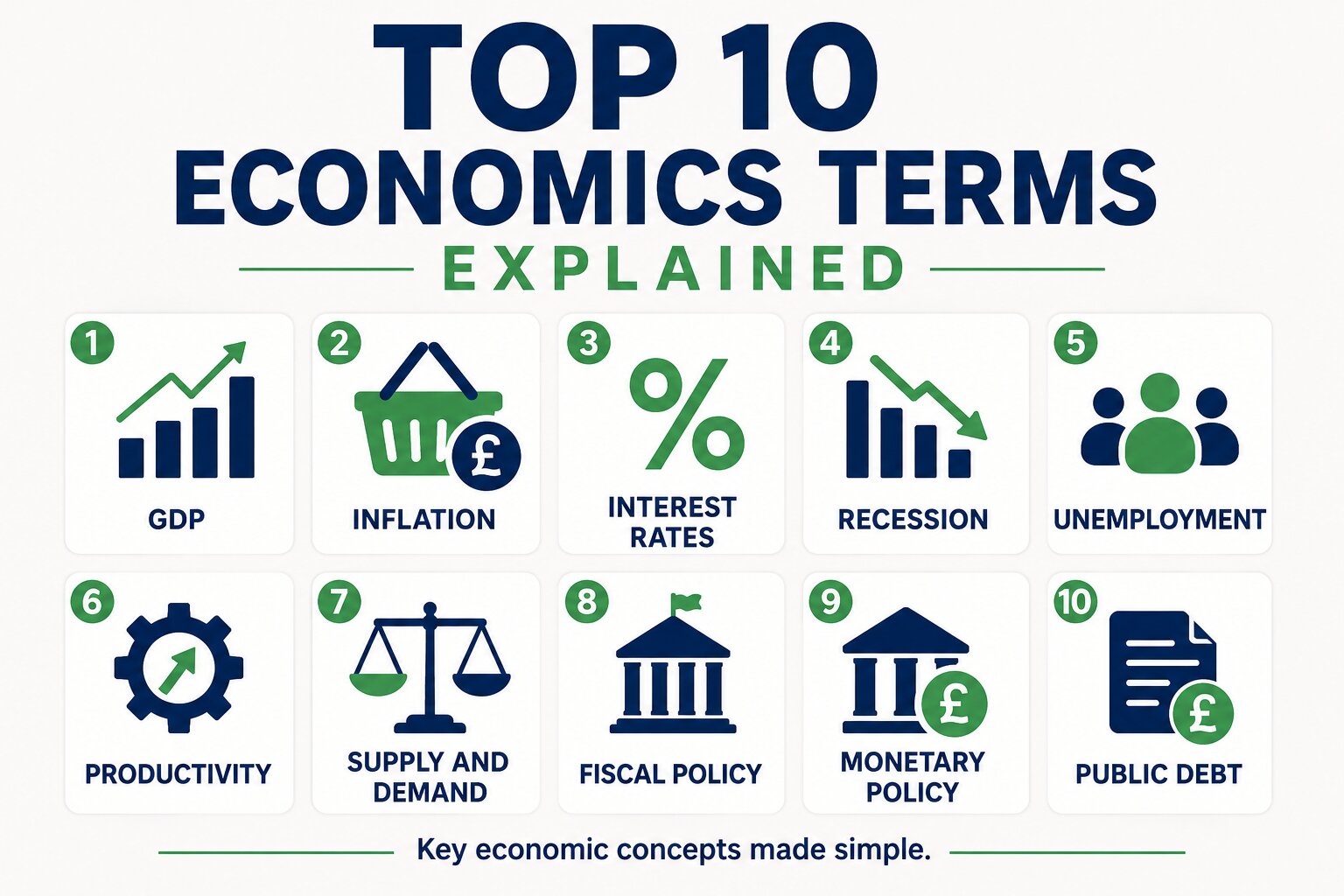
This guide explains 10 common economics terms in plain English. It is designed for readers who want a clearer understanding of economic news without needing a background in economics.
1. GDP
GDP stands for gross domestic product. It measures the value of goods and services produced in an economy over a period of time.
In the UK, GDP is one of the main ways economists judge whether the economy is growing or shrinking. If GDP rises, the economy is producing more than before. If GDP falls, the economy is producing less.
GDP includes goods such as food, machinery, cars and clothing, as well as services such as healthcare, education, banking, construction, transport, hospitality and retail.
When news reports say the UK economy grew by a certain percentage, they usually mean that GDP increased.
GDP matters because it can affect jobs, wages, tax receipts, business investment and public spending. However, GDP does not tell you everything. It does not show how income is shared, how secure people feel or whether households are keeping up with rising costs.
For a deeper explanation, our guide to UK GDP explained looks at what the measure means for households and businesses.
2. Inflation
Inflation means prices are rising across the economy.
If inflation is 5%, it means prices are, on average, 5% higher than they were a year earlier. Inflation does not mean every price rises by the same amount. Food may rise faster than clothing. Rent may rise faster than entertainment. Energy bills may rise sharply while some goods stay fairly stable.
Inflation matters because it reduces purchasing power. If your income stays the same but prices rise, your money does not go as far.
For households, inflation can affect groceries, transport, housing, energy, insurance and other everyday costs. For businesses, it can increase wages, materials, rent, borrowing and operating expenses.
A low and stable rate of inflation is usually seen as normal. High inflation can be difficult because wages, benefits and savings may not keep up.
3. Interest Rates
Interest rates are the cost of borrowing money or the reward for saving money.
If you borrow money, the interest rate affects how much extra you pay back. This can apply to mortgages, personal loans, credit cards, overdrafts and business finance.
If you save money, the interest rate affects how much your savings may earn.
In the UK, the Bank of England sets Bank Rate. This influences many other interest rates across the economy, although it does not control every rate directly.
When interest rates rise, borrowing usually becomes more expensive. Mortgage payments may increase for some borrowers, loans can cost more and businesses may become more cautious about investment.
When interest rates fall, borrowing may become cheaper, but savers may earn less.
Interest rates are often changed to help manage inflation and economic activity.
Interest rates are ultimately associated with a number of products. Whether you are looking for a mortgage from someone like Yorkshire Building Society, or a loan for a new car, an interest rate will be applied).
4. Recession
A recession is commonly described as two consecutive quarters of falling GDP.
A quarter is a three-month period. If the economy shrinks for two quarters in a row, it is usually said to be in recession.
Recessions can happen for many reasons. These may include high inflation, rising interest rates, financial crises, falling confidence, global shocks, weak trade or sudden events such as a pandemic.
During a recession, businesses may reduce investment, hiring may slow, unemployment may rise and households may become more cautious with spending.
Not all recessions are the same. Some are short and mild. Others are deeper and longer-lasting. The impact can also vary by industry and region.
Understanding the UK economic growth rate through history can help put recessions and recoveries into context.
5. Unemployment
Unemployment measures people who are not currently working but are actively looking for work.
It is an important economic indicator because jobs are one of the main ways people earn income. When unemployment rises, more households may face financial pressure. Consumer spending may weaken, and demand for government support may increase.
When unemployment is low, more people are in work, tax receipts may be stronger and household confidence may improve.
However, unemployment does not tell the whole story. Some people may be working fewer hours than they want. Others may be in insecure or low-paid work. Some people may not be counted as unemployed because they are not actively looking for work, even if they would like a job in different circumstances.
This is why economists also look at wages, vacancies, inactivity and job quality.
6. Productivity
Productivity measures how much output is produced from a given amount of work.
For example, if a worker can produce more goods or services in the same number of hours, productivity has improved. Productivity can rise because of better technology, training, management, equipment, infrastructure or working methods.
Productivity matters because it is one of the main drivers of long-term economic growth and living standards.
If businesses can produce more value without simply increasing hours or costs, there may be more room for wages and profits to rise. Higher productivity can also make an economy more competitive.
Weak productivity growth can make it harder for wages to rise and public finances to improve. This is why productivity is often discussed in economic debates, even though it may sound less familiar than inflation or interest rates.
7. Supply And Demand
Supply and demand are two of the most basic ideas in economics.
Supply means how much of something is available. Demand means how much people want to buy.
If demand rises and supply stays the same, prices may increase. If supply rises and demand stays the same, prices may fall.
For example, if many people want to rent homes in an area but there are not enough properties available, rents may rise. If a product becomes easier to produce and more widely available, prices may fall.
Supply and demand affect many parts of the economy, including housing, food, fuel, labour, consumer goods and business services.
This idea is simple, but real markets can be complicated. Prices may also be affected by regulation, taxes, transport costs, wages, global events, competition and consumer confidence.
8. Fiscal Policy
Fiscal policy refers to government decisions about tax, spending and borrowing.
Governments collect money through taxes and spend money on public services, benefits, pensions, infrastructure, defence, healthcare, education and other areas.
If the government spends more than it receives in tax, it usually borrows. This creates a deficit. Over time, borrowing adds to public debt.
Fiscal policy can affect the economy directly. Higher public spending may support jobs, services and demand. Tax cuts may leave households or businesses with more money, depending on how they are designed. Spending cuts or tax rises may reduce borrowing but can also reduce demand.
Fiscal policy is one of the main ways governments influence the economy.
9. Monetary Policy
Monetary policy refers to actions taken by a central bank to influence inflation, borrowing, spending and economic activity.
In the UK, monetary policy is mainly managed by the Bank of England.
The most familiar monetary policy tool is interest rates. If inflation is too high, the Bank may raise interest rates to reduce borrowing and spending pressure. If the economy is weak and inflation is low, it may lower rates to encourage borrowing and activity.
Monetary policy can affect mortgages, savings, business loans, exchange rates and consumer confidence.
Fiscal policy is about government tax and spending. Monetary policy is about central bank decisions, especially interest rates and financial conditions.
For a broader introduction to the wider economy, our article on what macroeconomics means explains how these ideas fit together.
10. Public Debt
Public debt is the total amount of money the government owes.
It builds up when the government borrows money over time. Borrowing may be used to fund public services, investment, emergency support, tax shortfalls or crisis responses.
Public debt is often discussed as a percentage of GDP. This compares the amount owed with the size of the economy.
Debt is not the same as the deficit. The deficit is the gap between government spending and income over a period of time. Debt is the total amount owed from past borrowing.
Public debt matters because interest payments can take up part of government revenue. If borrowing costs rise, debt can become more expensive to manage.
However, public debt also needs context. Governments may borrow during recessions, wars, financial crises or pandemics to support the economy. The key question is whether debt remains manageable and whether borrowing is being used effectively.
For readers who want more definitions like this, our guide to macroeconomic terms defined covers a wider range of economic language.
Why These Terms Matter
These economics terms matter because they describe forces that affect daily life.
GDP can influence jobs and public finances. Inflation affects the cost of living. Interest rates affect mortgages, loans and savings. Recessions can affect employment and business confidence. Productivity shapes long-term wages and living standards.
Economic language can sometimes make ordinary issues sound distant or technical. In reality, these terms often describe familiar pressures: rising bills, changing pay, job uncertainty, business costs, government support and borrowing decisions.
Understanding the terms does not mean predicting the economy perfectly. It simply helps readers follow the news with more confidence and understand why certain figures receive attention.
How To Read Economic News More Clearly
When reading economic news, it helps to ask a few simple questions.
What is being measured? Is the article talking about GDP, inflation, unemployment, wages or government borrowing?
What period does the figure cover? A monthly figure may tell a different story from an annual figure.
Is the number adjusted for inflation? This matters when comparing income, wages or growth over time.
Who is affected? A national figure may hide different experiences by region, age, industry or income group.
Is the change large or small compared with history? A guide to UK GDP and economic growth can help put current figures into context.
Economic news is easier to understand when terms are separated clearly and read alongside other indicators.
Clear Finance And Economics Writing
Simple economic explanations can help more people understand the financial world around them.
Commerce Grants publishes guides on finance, grants, government support, education funding and economic topics. Writers who want to explain money topics in plain English can review our Write For Us – Finance page.
Good economic writing should avoid jargon where possible, define terms clearly and explain why the subject matters to real people and businesses.
Conclusion
Economics terms such as GDP, inflation, interest rates, recession, unemployment and public debt are used constantly in financial news. They can sound complicated, but the basic meanings are straightforward once they are explained clearly.
GDP measures the size of the economy. Inflation measures rising prices. Interest rates affect borrowing and saving. Recession describes a period of economic contraction. Unemployment measures people looking for work. Productivity helps explain long-term growth.
These terms are useful because they help connect national economic figures with everyday financial pressures.
Understanding them makes it easier to follow economic news, compare government announcements and see how changes in the wider economy may affect households, businesses and public finances.